
Expert panelists weigh in on Manse Tech data center
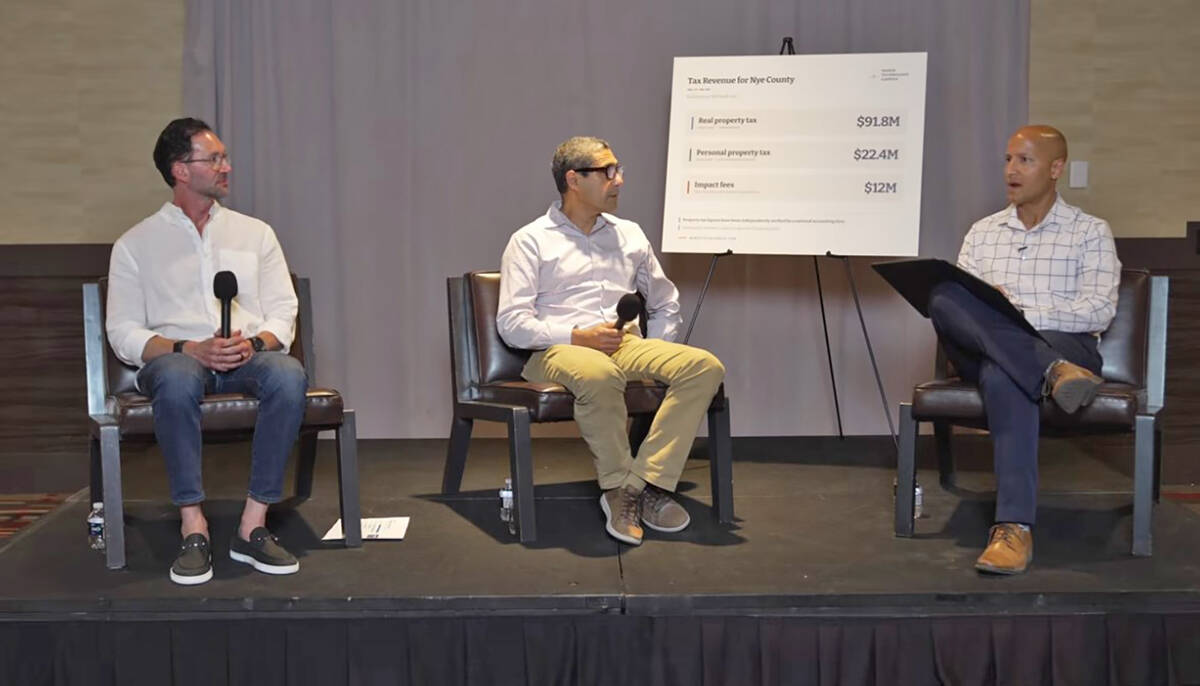




In a continued effort to calm local consternation over its project, last week the developers behind the proposed Manse Tech Campus released a recorded video featuring several expert panelists, each of whom provided their take on the safety and viability of the project.
Originally scheduled to take place in-person, the panelist discussion was shifted to an online format as a result of the public’s overwhelming response to the proposal, which has drawn fierce opposition from a large percentage of the local population. Over the course of roughly 45 minutes, the panelists talked about a variety of the concerns that have been voiced and much of the information presented echoed that which had already been released by the Manse Tech Campus team previously. This included employment figures, projected water use, investment totals, tax revenue, adherence to local night sky ordinances and more.
The video opens with Tim Sutton, a longtime Pahrump resident and former Nye County manager, who is consulting for the project. Senior civil engineer Syndi Dudley, senior data center engineer Sam Abdelfattah, senior acoustical engineer Kody Snow and developer Sean Dalesandro completed the panel.
Dudley started with an overview of what data centers are and their purpose in the tech industry.
“Every time we jump on our phone or open an app or surf the web, the data centers are working hard in the background to store and process that information. Data centers just house the servers that deliver that digital information to us,” Dudley explained.
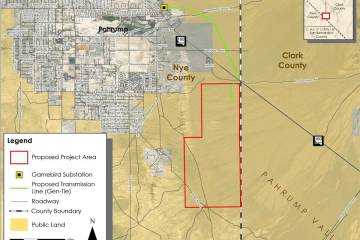
She went over the specifications of the location, which is 900 acres on both sides of Highway 160 at Manse Road. There are 20 buildings planned, with a maximum height of 75 feet, as well as three substations, a transmission line, water tanks for fire suppression and flood control infrastructure. The buildings are also designed to blend into the natural environment, she noted.
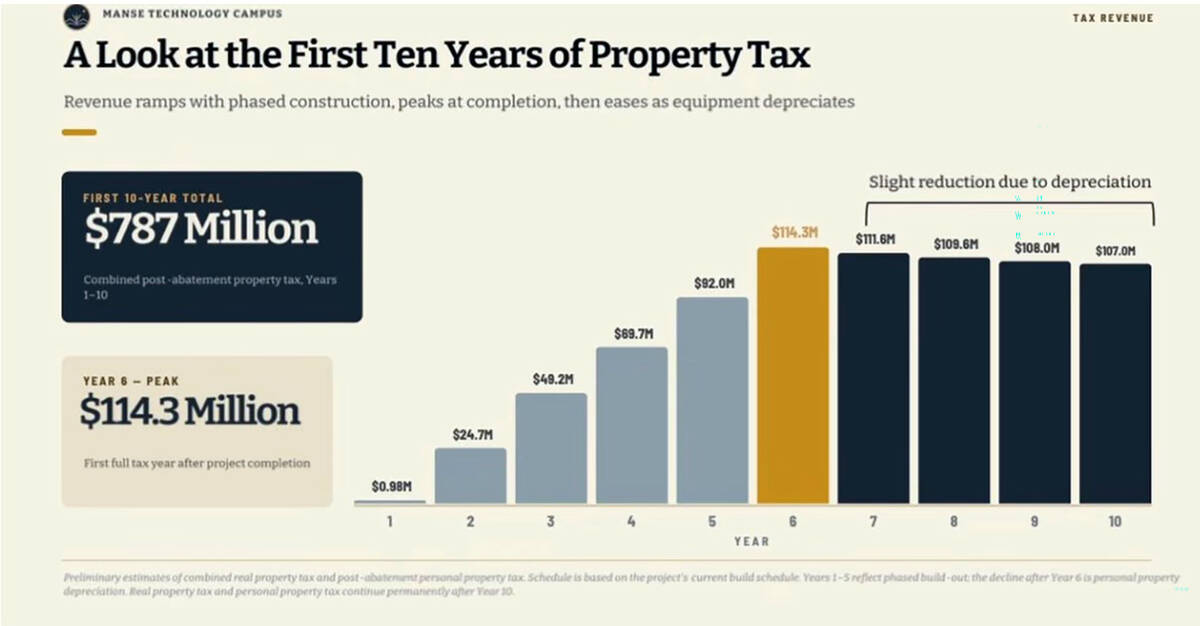
Dalesandro then addressed potential tax revenue for the county, the figures for which were created by an unnamed accounting firm. Real property taxes were projected to be $91.8 million per year, with an additional $22.4 million in personal property taxes at its peak. “And that’s post-abatement,” he noted, referring to the state’s tax abatement for the project.
A further $12 million would also be paid, for one-time county impact fees that go toward parks, roads, the fire department, sheriff’s office and flood control.
On the topic of water, Abdelfattah addressed the cooling process, which is proposed as a closed-loop system.
“I have been doing design for commercial application and industrial applications since 1999 so I can tell you with all honesty, we’re not going to use more water than a golf course, a large residential development and much less than industrial applications,” Abdelfattah stated.
“The water infrastructure that is going to be installed by this project will ultimately be dedicated back to the utility, for public use,” Dudley added.
Sutton then brought up a situation in Wyoming, where a Meta data center has been linked to contaminated wastewater caused by a flush of the closed-loop cooling system. Abdelfattah said he did not know the facts on that case but asserted that in any well-designed system, backflow prevention is imperative.
Various other public concerns were brought up, as well, including electromagnetic field generation and heat.
“The EMF energy or waveforms that would be produced are not much more than you would encounter in a school environment or office environment or even in the house, at the computer or the TV,” Abdelfattah said.
On the heat front, Abdelfattah claimed that the heat will dissipate quickly into the atmosphere, remarking, “I don’t foresee that as an issue.”
Snow focused on the sound aspect, explaining that computer modeling was used to determine how the Manse Tech Campus might impact noise in the area. He said the sound levels would vary based on distance from the project, with those located within a few miles of the project to expect between 46 and 54 decibels on a continuous basis.
“The mid-50 decibel range is quite similar to what is typical of a suburban daytime noise environment. Again, something else to consider is, there is a pretty heavily traveled roadway that does intersect the site,” Snow said. “Based on evaluation of publicly available roadway data, through the DOT for this roadway, the noise levels that have been calculated from this are very similar to the noise levels that we’re predicting for these residential receptors.”
Snow noted that mitigation measures, such as compressor wraps, could be incorporated to reduce those levels. Building placement could also be taken into account, to increase distance between noise sources and homes.
Power usage was also touched on, with Abdelfattah detailing that Manse Tech Campus would be installing additional infrastructure to support the project.
“Where does this power come from? Where does this project purchase power from?” Sutton queried.
“Some of this power probably will come from renewable resources, some will come from thermo-generation that are located remote or far from this area,” Abdelfattah said. He added that there will be many studies and models required prior to final approvals, to gauge the effects on the local electrical infrastructure and supply.
Coming to the crux of the matter for many, Sutton then concluded by asking Dalesandro, “Why should the residents of Pahrump trust you at all?”
“They don’t have to trust me. It’s our objective to provide the most reliable and transparent information on our project as we possibly can but at the end of the day, they are going to discount the source. But they don’t have to trust me. All of these different figures that we’re putting out there can be added to a development agreement with the county and they hold the paper and the ability to enforce that agreement,” Dalesandro responded. “The tax abatement that we discussed is a direct agreement with the state and they have the ability to enforce those different conditions on us. So, you don’t have to take my word for it. That will all be in the hands of the county and state, to enforce those agreements.”
The video closes with Dalesandro encouraging residents to submit questions and concerns through the project website and to keep an open mind going forward.
The video and feedback portal can be found at ManseTechCampus.com
Contact reporter Robin Hebrock at rhebrock@pvtimes.com