
MediWaste public hearing draws 100-plus concerned residents
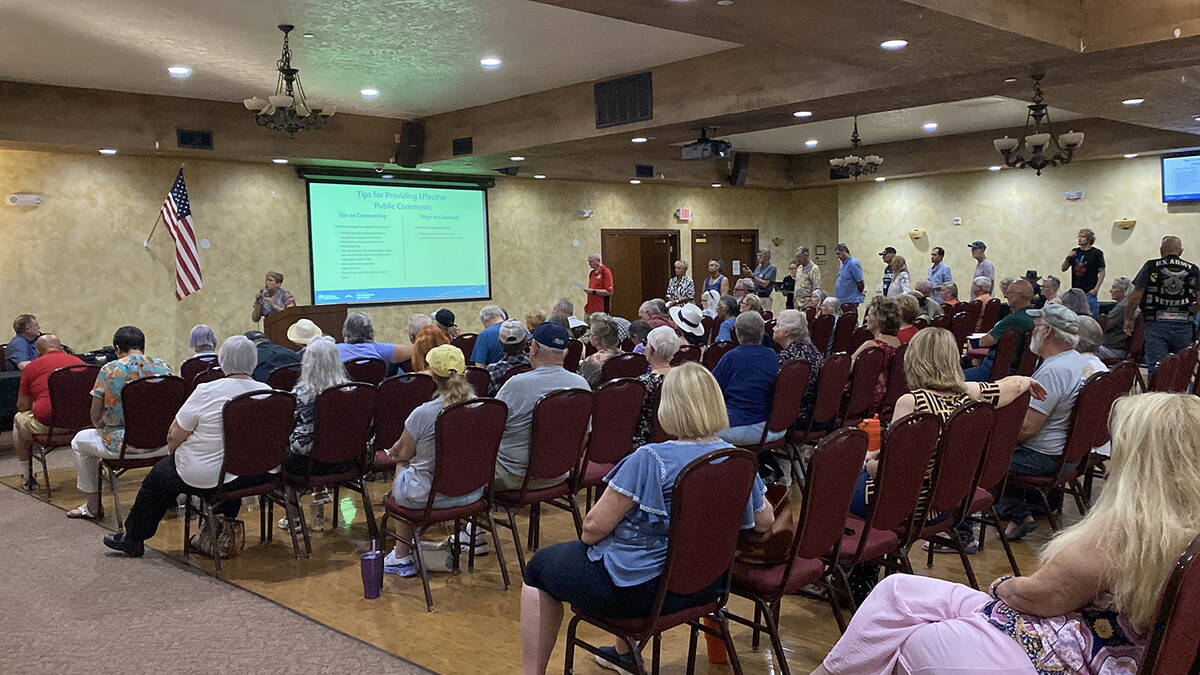




The Nevada Division of Environmental Protection – Bureau of Sustainable Materials Management (BSMM) hosted a public hearing on the pending permit for the MediWaste Disposal LLC project in Pahrump this week and concerns about the proposal prompted upward of 100 people to make their way to the Nevada Treasure RV Resort for the meeting.
Held Tuesday, July 7 from 6 to 8 p.m., the public hearing opened with NDEP Deputy Administrator Jeffrey Kinder explaining that the proceedings would be recorded so that the division could accurately capture comments. Additional written comment was also taken through the close of business on Wednesday for those who were not able to speak that evening. Kinder noted that every person who provided comments and a contact would receive a follow-up directly from NDEP within 30 days.
BSMM Bureau Chief Annalynn Settelmeyer then provided an overview of the permitting process before handing it over to permitting supervisor Jonathan Zittel, who delved into the details of the MediWaste proposal.
MediWaste aims to create a medical waste pyrolysis facility within two existing structures at 1850 E. Basin Avenue, approximately 370 yards west of the DMV and other local businesses.
“The process with MediWaste began on May 6, 2024 when the BSMM received MediWaste’s initial application,” Zittel told the audience. “On Feb. 18, 2025, MediWaste submitted a revised application with a different process that only generated hydrated ash as a product of the process. In total, there have been six application versions submitted, multiple rounds of BSMM comments, two in-person meetings and a March 2026 draft fact sheet. The permit and fact sheet were sent out for public comment on April 1, 2026, initiating public notice. MediWaste must address the schedule of compliance items listed in the draft permit.”
Under Nevada Administrative Code (NAC), there are no site requirements for an operation of this type, Zittel stated, and as the system uses no oxygen, it does not fall under the state’s incinerator regulations. Additionally, there are no groundwater protection requirements for pyrolysis facilities but the BSMM did take it into consideration, he said. However, MediWaste claims that its medical waste packaging for incoming loads is waterproof and leakproof and that once processed, the hydrated ash will be placed in covered, 40-cubic yard bins before ultimately being disposed of – but not at the Pahrump landfill, which is not permitted to accept this type of waste.
Zittel said the BSMM is requiring several updates/corrections to the permit, as well, including reducing the on-site storage limit from 30 days to 15 days, increasing the reporting frequency from annually to quarterly and adding embryos to the prohibited waste list. The maximum average daily permitted throughout was corrected from 16.8 tons per day to 41.4 tons per day and the parcel ID number needs to be confirmed. MediWaste will also be required to provide all emergency plans and any updates to those plans to the local fire department and first responders and will need to provide the BSMM with the Spill Prevention, Control and Countermeasure and Stormwater Pollution Prevention Plans, as referenced in the application for review. MediWaste must address the measures that are in place to prevent wind-driven release or migration of materials, to include any wind-speed operational limits, enclosed or controlled handling procedures, physical containment and housekeeping protocols. The company must also address dust generation, accumulation and weather ignition risks have been evaluated or mitigated.
“Note, the preliminary conditions listed above are not exhaustive and may change,” the BSMM added.
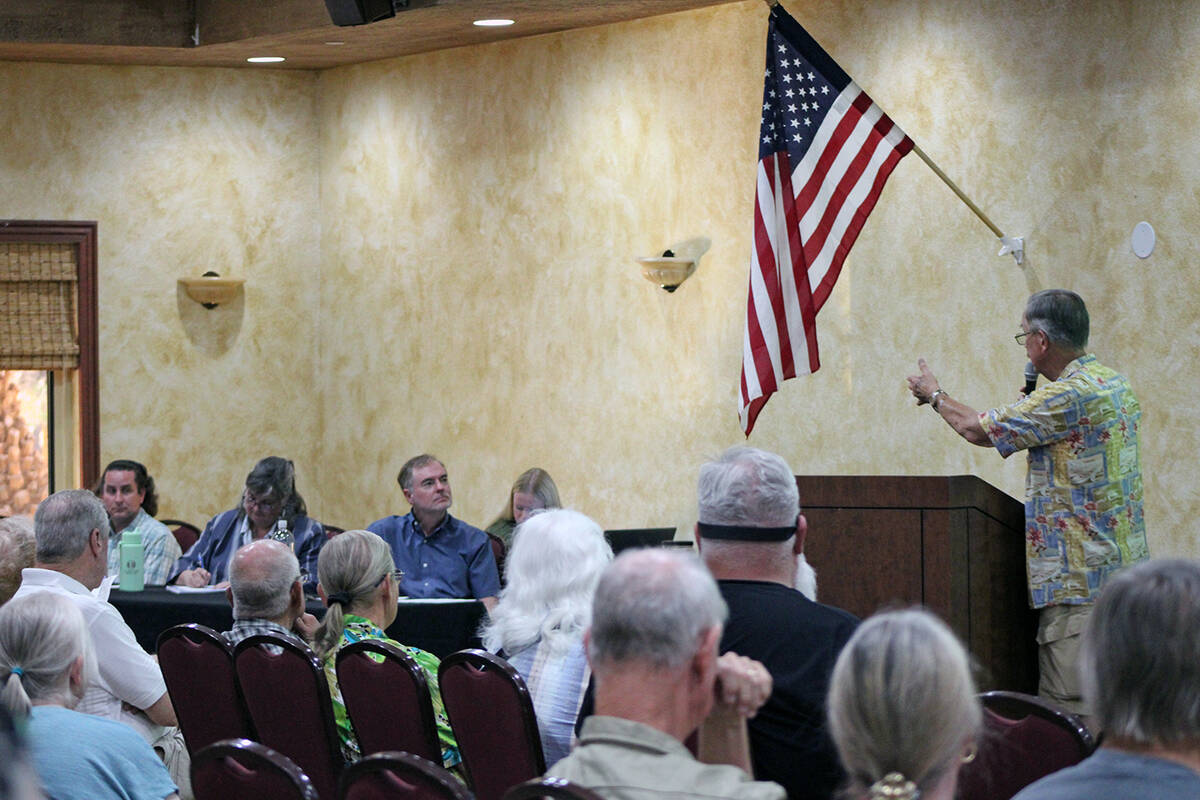
Before public comment opened, Settelmeyer provided some tips for effective comments, asking attendees to stick to specific permit details that do not meet the regulations of NAC 444 and recommended actions, rather than opinions. While many did just that, others did not stifle their emotions. Roughly two dozen people spoke that evening and not one was in favor of the proposal.
“I oppose the proposed medical waste treatment facility in Nye County, due to the extreme vulnerability of the Pahrump aquifer,” Laura Larsen asserted, adding that local infrastructure, particularly roads, would be negatively impacted by the incoming loads.
John O’Brien declared that the information on MediWaste’s proposal has changed so many times that no one really knows what to believe or if the information is trustworthy. As someone with a chemist background, O’Brien demanded a chemical analysis of every product to be processed, asserting that forever chemicals could result from the pyrolysis operation.
Stephen Pitman then pointed out that the medical waste to be processed would be coming from several different jurisdictions and each can have its own classifications and separations requirements for such waste. “That means the emissions analysis depends on an important assumption – that the waste being received is chemically representative of the waste used to develop the permit,” Pitman stated before asking the BSMM to explain how the variability between jurisdictions was analyzed.
These were far from the only concerns raised, with several commenters proclaiming that all the safety plans in the world cannot guarantee some sort of accident does not occur and others asking who would be financially responsible in the event that an emergency situation did happen. Still others reiterated that Pahrump has only one source of water and contamination would make the town unlivable. Some scoffed at the idea of storing the incoming medical waste in containers outdoors in Pahrump’s intense heat, as well as storing the processed ash in covered bins due to the wind storms that the area regularly experiences. There was even a petition presented that night, with around 465 signatures on it from residents who do not want MediWaste to bring their operation to the valley.
Linda Clark seemed to sum up the general public’s feeling toward the project, telling the BSMM and MediWaste representatives, “’No’ is what you’re going to get from this community. You’re not going to convince very many of us that this is what we want or we need.”
As to what happens next, Zittel said the BSMM will be reviewing all comments and will respond to each commenter. There will also be a compiled list of responses that will be made available to the public.
“The BSMM will then decide to issue or deny the permit, pursuant to NAC 444.6425,” Zittel said. “Please note that per NAC 444.6425.2 conditions or modifications may be placed on a permit issued because of public comments received.”
Kinder added that in the event that the permit is issued, the BSMM would continue to be engaged with MediWaste throughout the life of the permit. However, the permit is not the final step, as MediWaste must first secure a license through Nye County.
All MediWaste application files, correspondence and facility records are publicly available online at NDEP-OnBase.NV.gov. Locate the files by selecting “NDEP-BSMM Facility Files” and entering MediWaste as the facility name.
Contact reporter Robin Hebrock at rhebrock@pvtimes.com