
STEVE SEBELIUS: James Comey on leadership
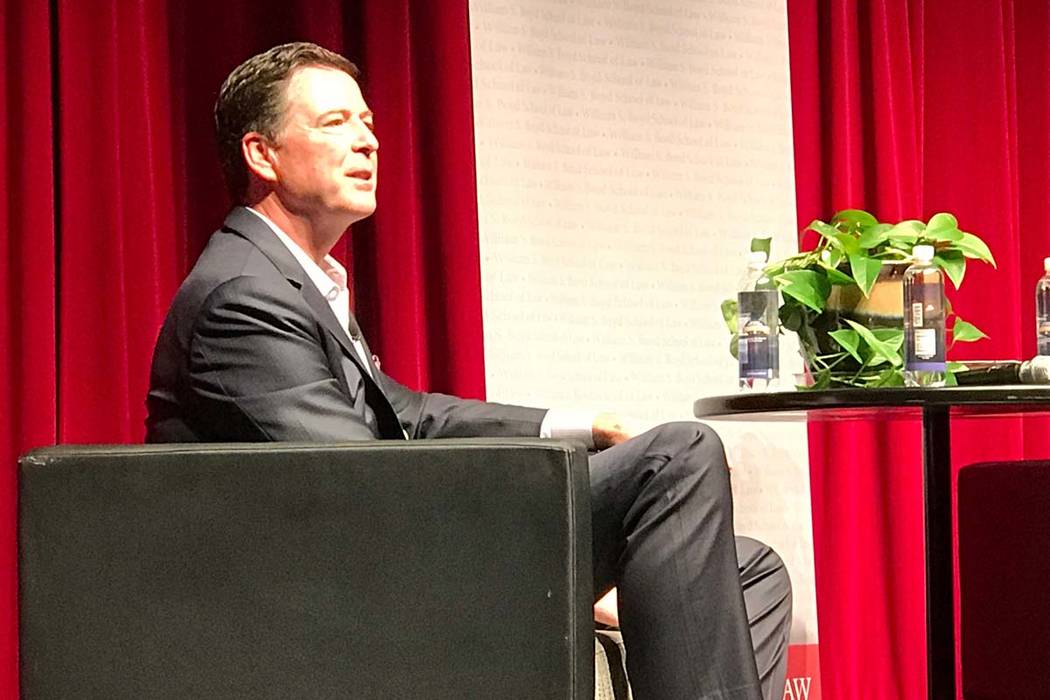





Former FBI Director James Comey knows a thing or two about leadership.
A former federal prosecutor who took on the mob, terrorists and street criminals, he’s served at the top levels of the Justice Department and stood up to two different presidents for very different reasons.
Comey shared some of his lessons on leadership at the William S. Boyd School of Law’s second Law and Leadership program last month. Interviewed by former Gov. Brian Sandoval — the program’s leader — Comey talked about what he’d learned about leading.
Good leaders lead from the front. Comey said he took time when at FBI headquarters in Washington, D.C., to get his own lunch in the building’s cafeteria, coatless and with his security detail at a distance. He’d ask FBI employees about their jobs and get to know them as people.
The exercise served a dual purpose, helping Comey understand the people who worked for him, as well as letting them see him as a flesh-and-blood person, rather than as the director. And, he said, he never cut in line despite repeated invitations to do so because of his rank.
“You and I are God’s creatures, right?” he said. “There’s no difference. I’m not going to cut in line on you.”
Good leaders, Comey said, put their people center stage rather than take that spot for themselves. Comey was sure to credit the police officers, FBI agents and prosecutors who worked with him fighting gun crimes in Richmond, Virginia, what he recalled as one of his best law-enforcement posts. A politician in his spot might claim credit for cleaning up the town, but Comey pointed the spotlight on his subordinates, who carried out his priorities.
Comey said he’d look for that leadership quality at FBI headquarters. When he asked for information about a particular topic, he’d note which of his deputies would bring their subordinates to brief him, as opposed to those who would collect the information from their people and then brief the director themselves.
Leaders never ask for loyalty, Comey said. He used the example of former Marine Corps Gen. James Mattis, who recently resigned as secretary of Defense. “Jim Mattis was a fellow who led United States Marines for decades. I guarantee you, he never asked them for loyalty,” Comey said.
Instead, he set high standards and made sure his Marines had the resources to do the job. “And by all that giving and giving and giving, he got something in return, much more important than loyalty, which is transactional. He got love,” Comey said.
Leaders take care to preserve the institutions they serve, Comey said. That’s what he said he was doing when he made the decision to inform Congress that the FBI — shortly before the 2016 election — had discovered a new trove of Hillary Clinton emails relevant to a then-closed investigation. Even though he knew the revelation could (and did) affect the election, he feared not reporting the evidence and having it come out later would greatly damage the FBI.
But leaders are also humble, Comey said. Although he says he’d make the same decision again given the same circumstances, he frankly admits he’s not sure he was right. “If I was certain I was right, I’d be a moron,” Comey said. “I’m still not certain it was the right decision.”
Leaders stand up for their principles and for the rules, even in the face of intense pressure. Comey told the now-famous story of rushing to the bedside of ailing Attorney General James Ashcroft to prevent two top White House aides — then-Chief of Staff Andy Card and then-White House Counsel Alberto Gonzales — from forcing Ashcroft to sign off on a surveillance program that top Justice Department officials had determined had an infirm legal basis.
Although the president wanted the program — and former Vice President Dick Cheney warned him that people would die as a result of canceling the program — Comey stood firm. And when the president’s men arrived, Ashcroft told them in no uncertain terms he would not sign, and that, because of his illness, Comey was then the acting attorney general of the United States.
“That was the hardest thing I’d ever been involved in,” Comey said. “I had no idea.”
Comey said he had a “distant and cold” relationship with President Donald Trump before the president fired him, but said an FBI director should maintain a separation from the president. Former President Barack Obama told Comey when he was hired as director that the president simply wanted the bureau to have solid, competent leadership.
Eschewing the spotlight. Putting the focus on other people. Protecting the institution. Respecting the rules. Standing by principle, no matter the political cost. Staying humble. Never demanding loyalty.
Sound like the mirror opposite of anybody you know?
Steve Sebelius is politics and government editor at the Las Vegas Review-Journal.