
From snowy roads to state semifinals: Awkward Silence Robotics builds more than robots
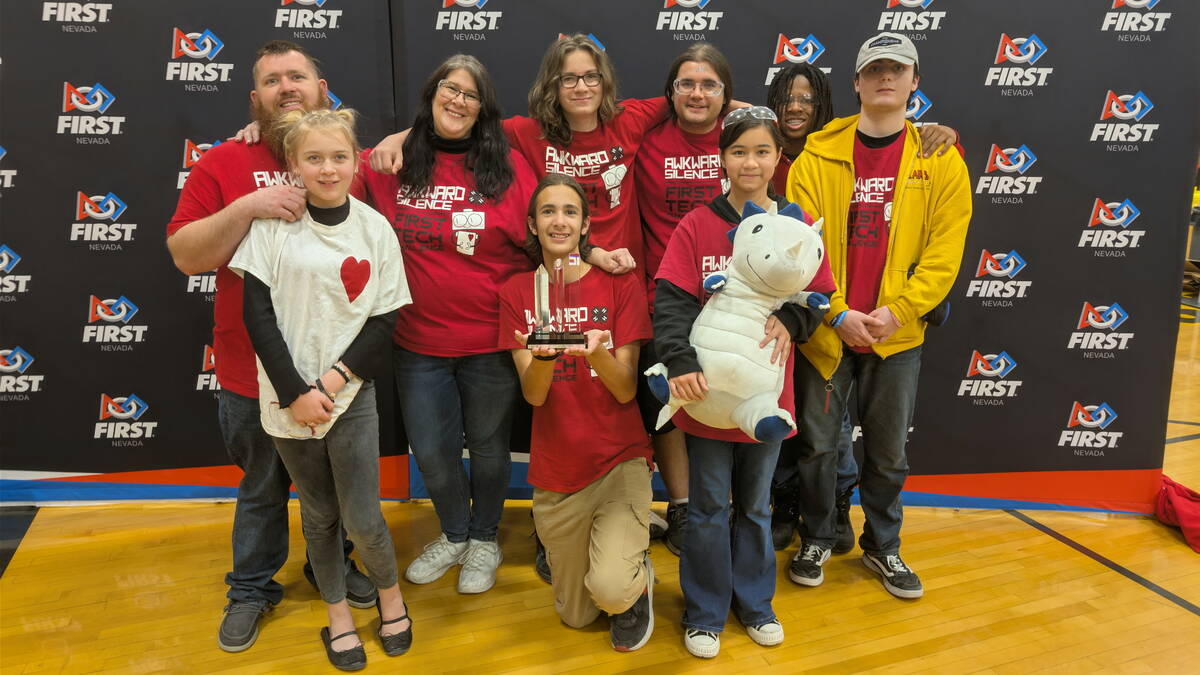
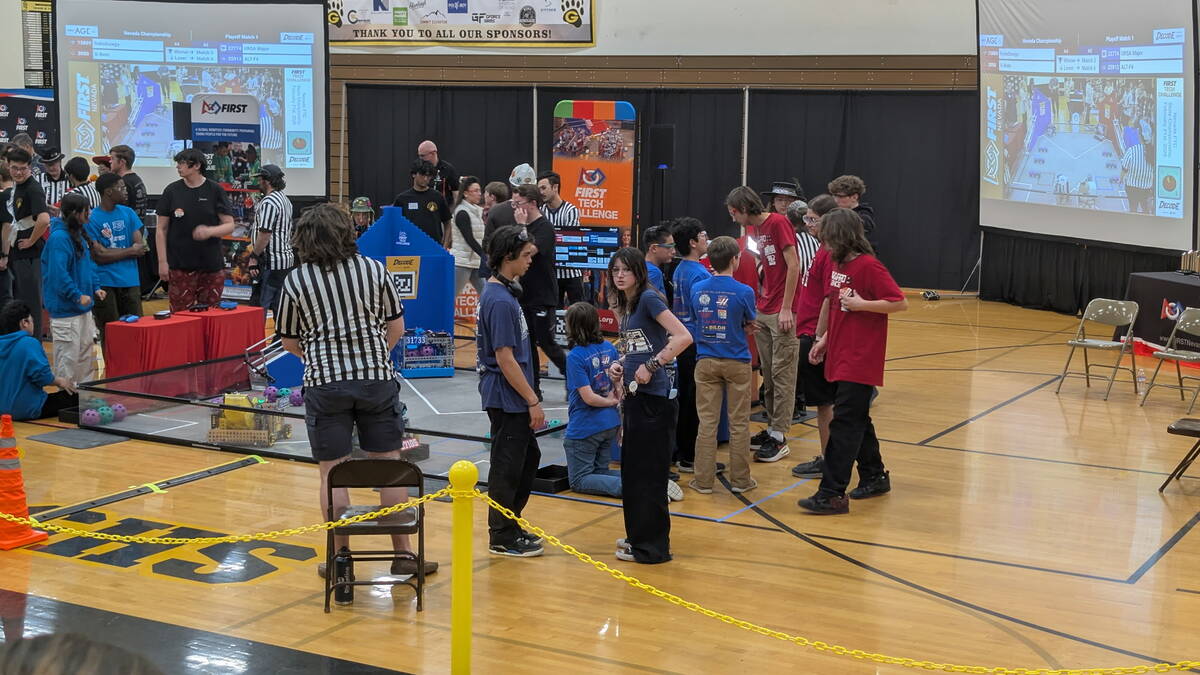
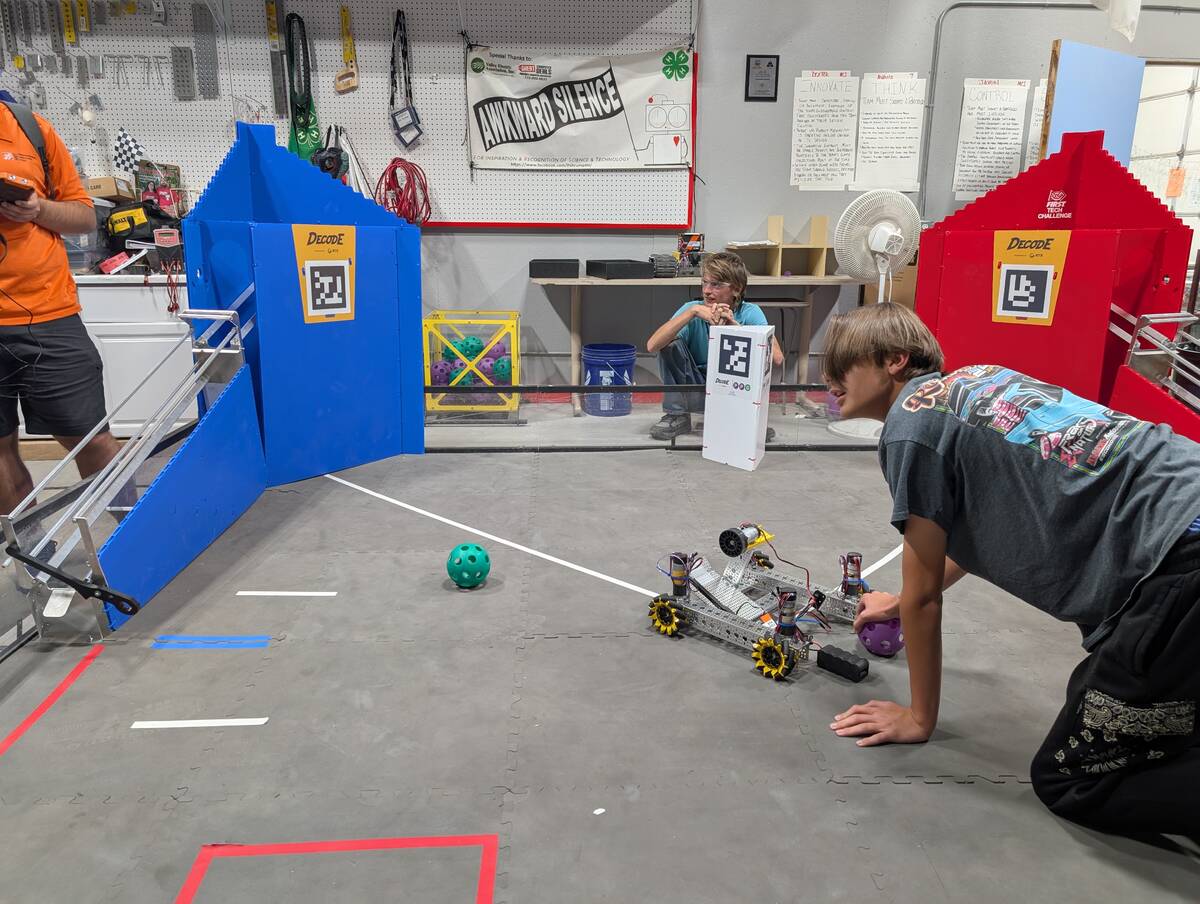



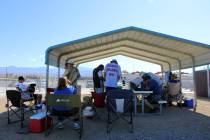
When Pahrump’s local 4H robotics program, Awkward Silence, loaded into their van and headed north for the Nevada State Robotics Championship last Thursday, the forecast called for snow, wind, and uncertainty.
Traveling to the two-day FTC state championship hosted at Galena High School in Reno, the team knew the snow would probably be the least of their worries.
“My husband and I (Jason) both lived in Minnesota for four years, so driving in the snow is not something we’re not used to,” Awkward Silence head coach Jennifer Riendeau said.
What the forecast failed to predict was further proof that a small-town community team could stand shoulder to shoulder with Nevada’s most well-funded private programs.
Originally ranked 14th overall out of 47 teams heading into state, Awkward Silence climbed to 10th after alliance selections — when top teams got to personally select partners for playoff rounds.
Pahrump’s semifinal partner was a first-year team from Word of Life Christian Academy, known as the ‘Little G-Bots’. The academy hosts one of Nevada’s longest-running robotics programs, making the alliance especially meaningful.
“We’ve had a strong relationship with that particular group of teams to begin with, since our very first year we’ve made that connection with that group of kids,” Riendeau said. “That’s the one thing that’s really cool about this, is every year you stay connected to a lot of these teams.”
Fish are friends, not food
In robotics, like life, relationships truly matter.
Pahrump doesn’t always enjoy the best reception in competitions outside of the town as the host teams and fan bases can often be harsh.
Unlike many traditional sports, robotics fosters a culture where competitors actively help each other succeed.
The sport’s championships revolve around teams being able to build friendships throughout the season — connecting at competitions, staying in touch on Discord, and cheering each other on yearly.
If a team struggles during inspection, Awkward Silence students are often first to offer help — cutting new number plates, sharing extra Sony PlayStation controllers and troubleshooting mechanical issues.
The philosophy is simple: win because you performed well, not because someone else lacked resources.
That culture — known in the FIRST community as “gracious professionalism” — defines the program.
Six-seven — Sustain Award
The team entered the year with seven members and competed through league play and state competition with six.
Of those six members, four were brand new — a remarkable statistic for a program competing at such a high level.
The team was composed of Jaxon Riendeau (team captain), Pete Anderson, Prince Lamette, Ava Miller, Avani Lara, Dexter Aguilar and Charlotte Campbell, with Campbell not competing in the last two competitions.
”It’s a big responsibility to be the team captain, I try my best to always represent Awkward Silence well. I am really happy our team was able to make it so far this season. We had four new members ages 12-15, and part of our process this year was learning how to work together and finding each team member’s strengths. By the end we were able to pull it off,” Jaxon said. “Ranking 10th in the state and getting the trophy for the Sustain Award is something we are all really proud of. With the right help next season we hope to land a spot at the World Championships in Houston, Texas.”
Awkward Silence meets four to six hours per week during the regular season.
What separates strong teams from great ones is what happens outside those meetings.
Students conduct research, refine code, troubleshoot mechanical issues, and practice strategy on their own time.
“It’s the kids who want to go home and keep working that make the difference,” Riendeau said.
Three of the newest members advanced through the local 4-H robotics pipeline, which includes: FIRST LEGO League Explore (ages 6–8), FIRST LEGO League Challenge (ages 10–13) and the FIRST Tech Challenge (ages 13+).
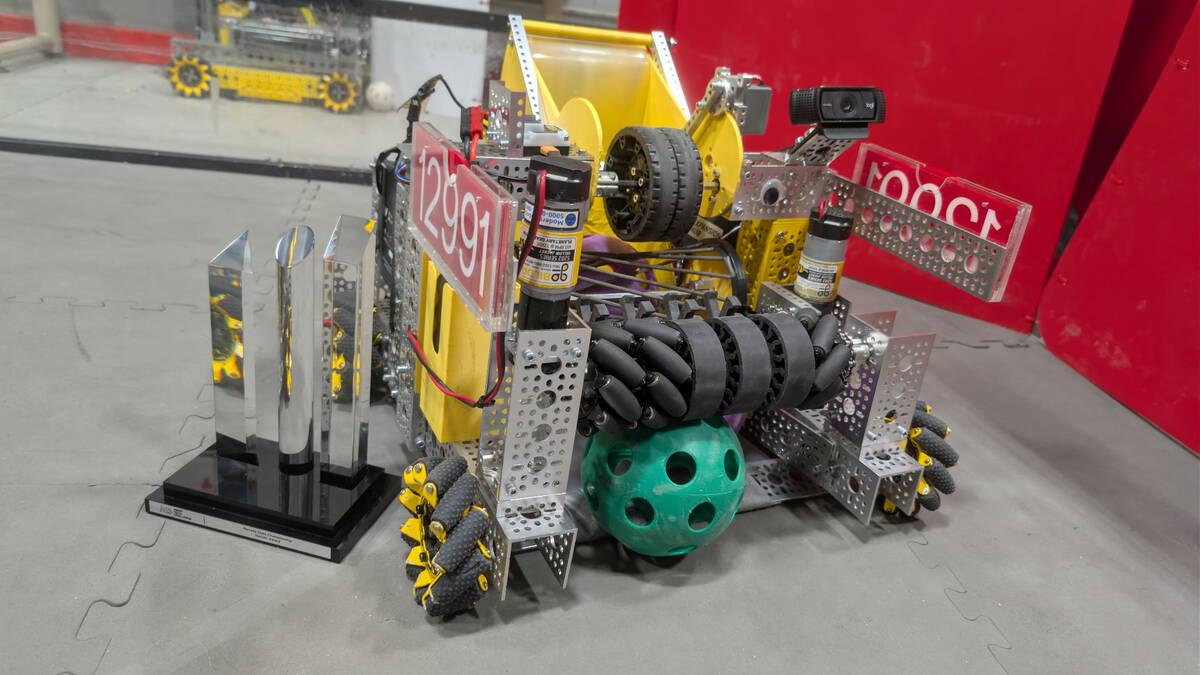
The structured progression paid off this year when Awkward Silence earned the prestigious Sustain Award at state — recognition given to teams that demonstrate long-term planning, financial stability, outreach, and program continuity that will follow after they have gone on to develop careers in the fields of science, technology, engineering, and mathematics.
The award was especially meaningful for coach Jennifer Riendeau because the local FLL Challenge program is only two seasons old.
Seeing students already rising through the ranks validates years of intentional program-building.
“It proves the feeder system works, it just takes time and consistency.” Riendeau said.
Well that’s … Awkward
And then there’s the name, almost akin to an early 2000’s pop punk band.
Unlike many teams named after mascots or technical jargon, Awkward Silence came from — quite literally — an awkward silence during the team’s first brainstorming session.
“Someone in the group said, ‘awkward.’ Another repeated it. Then silence,” Riendeau said. “And just like that, it stuck.”
The running joke among coaches?
“Definitely awkward,” Riendeau playfully joking said. “Not so silent.”
A new chapter in leadership
This season marked a major coaching transition for the team.
Longtime coach Jason Riendeau stepped back from his official coaching duties to focus on personal time — and a mini truck restoration project — while remaining an active mentor behind the scenes.
Stepping into the coaching role was his son Dylan, one of the team’s original members.
“It just gives me more flexibility,” Jason explained about the transition. “But I’m still here. I’m still helping and supporting.”
It’s less of a departure and more of a role swap — a reflection of how deeply invested families become in the program.
Leadership, much like engineering design, evolves.
Not without the communities support
Robotics is, quite simply, a costly sport.
Travel, equipment, and competition fees quickly add up — and upcoming rule changes requiring new control systems will add further financial strain to both the Awkward Silence program and the Pahrump Valley High School program.
Fortunately, the Pahrump community, as they often do for the youth, has stepped up year after year.
Among the most consistent supporters, Riendeau credits Apartments 247, Valley Electric Association, and Nevada Realty for their unwavering support.
These sponsors — along with several others — help ensure students can compete on an even-level playing field among well-funded private programs in larger cities such as The Meadows, Adelson and Bishop Gorman.
In return, the team often gives back their personal time, volunteering at community events and supporting local initiatives whenever possible.
“We’re very blessed to be in the position to offer any help someone may be needing,” Riendeau said. “So we show up when our community needs us.”
The programming gap
While the team has built strong community support, they continue to face a common rural challenge: access to technical mentors.
Right now, the team program is primarily using block-based coding systems.
But top-tier teams are writing in JavaScript, a much more proficient and technical system.
Those programs are using advanced tools like Road Runner and implementing odometry positioning systems that allow robots to auto-correct their field location with extreme precision.
In this year’s competition, defense and field positioning were critical in scoring.
One team’s robot was programmed so precisely that if it was physically pushed off its mark, it automatically corrected itself and returned to its exact coordinates.
That’s the edge Awkward Silence wants.
Students desperate to learn CAD design currently rely on YouTube tutorials.
The program hopes to recruit engineers willing to volunteer hands-on instruction this summer.
“The struggle is really trying to find people in an engineering field willing to come in and partner with our students and help teach them things that I don’t have the ability to teach them,” Riendeau admits. “So this summer, our goal is to find three people in the engineering field that can come in and help these kids learn.”
Looking ahead
While most sports programs enjoy a break between seasons, robotics operates differently.
“They say you build the Inspire Award in the off season,” Riendeau said.
And they mean it.
Awkward Silence is now focusing heavily on the following: fundraising, community outreach, mentor recruitment and summer programming.
The team missed its annual gala fundraiser — typically held in January — this year due to scheduling challenges.
The loss is significant as their last gala brought in about $2,500. By comparison, other local sports programs regularly raise $10,000 or more in a single season.
“If we could raise that kind of money,” Jennifer Riendeau noted, “we wouldn’t have to worry about whether we can afford robot parts.”
Contact Jacob Powers at jpowers@pvtimes.com. Follow @jaypowers__ on X.