
A dive into Robin Flinchum’s latest book



Robin Flinchum is an avid lover of Death Valley and this passion has inspired her writing for many years but her focus has primarily been on the real lives of women in the mining camps of this and surrounding areas.
Over a decade ago, however, she came across a name and life story in Northern Nevada that took root in her mind and has now blossomed into her newest book, “The Redemption of Julia Bulette: Murder, Myth and the Hunt for a Serial Killer in Early Virginia City”.
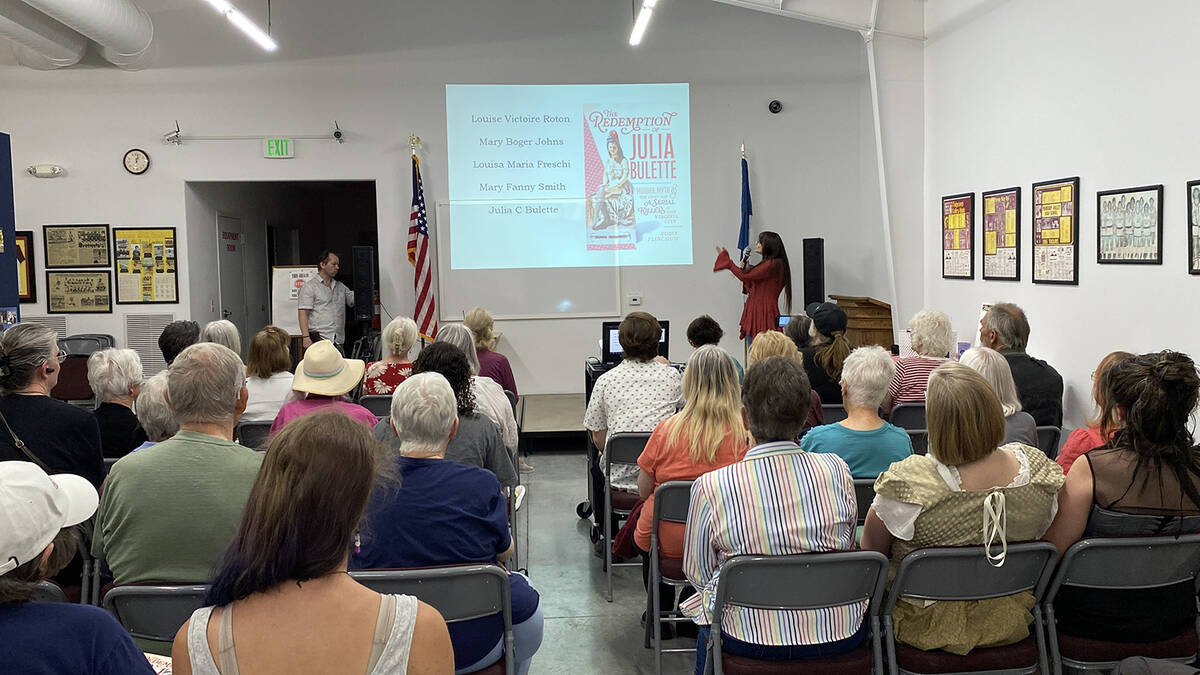
Since its release in April, Flinchum has been making appearances at locations around Southern Nevada and last month, she was in Pahrump for a presentation on the book that teases out the facts from the fiction in a tale that has become legend. Taking place at the Pahrump Valley Museum, the Saturday, May 30 event attracted dozens of interested locals, all eager to learn more and to get a signed copy.
“I’m so excited to be here, I love the Pahrump Museum!” Flinchum enthused before launching into her presentation.
She said one of the most frequent queries people have when talking about Julia Bulette is, where did she come from and how did she end up a prostitute in Virginia City?
“And that’s a question I will tell you, straight up before we get started, that I still don’t really know. I don’t know beyond a shadow of a doubt or that I could point to facts and sources that say where Julia Bulette came from,” Flinchum stated. “In the writing of this book, what I ended up doing after a couple of years of banging my head on the genealogical wall was, just focusing on Julia Bulette in the time that the she lived in Virginia City. What her life was like in Virginia City and what her death meant to Virginia City, to the town itself and to the people who knew her.”
There are many claims made about who Julia Bulette was and a majority of what is known of her today is in fact, not verifiable information, Flinchum explained.
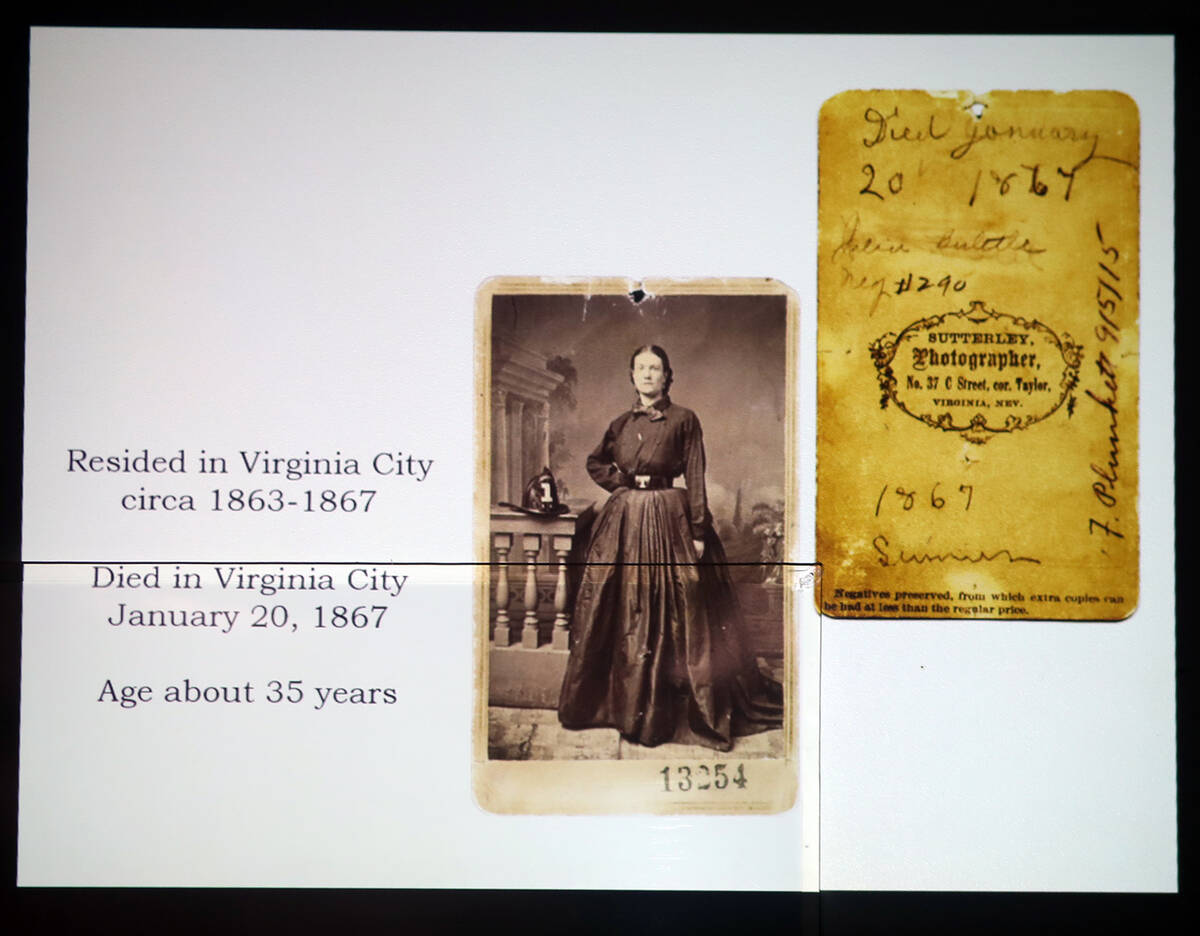
The facts that Flinchum were able to verify include that her death took place in 1867 at her home on D. Street and her accused killer, John Millian, was hanged for the crime just over a year later. Flinchum displayed an authentic photograph of the real Julia Bulette, pointing out that many are surprised when they see it, as it doesn’t match other depictions or their own ideas of the woman. In that photo, she is wearing a firefighter’s shirt and there is a firefighter’s helmet in the picture, due to her involvement with the Virginia Engine Company No. 1. At the time of her death, she was living in an area of Virginia City where prostitution was still legal and she had many friends. Proven through estate records, she was well-known and liked enough to draw on credit and shop in fashionable stores. Oddly, after she was killed, her home was briefly owned by the local Catholic priest but it burned down around 1870.
As Flinchum delved into her research on Julia Bulette’s murder, she originally pursued a course of presuming Millian’s innocence. But as she looked through historical records, she noticed that Millian’s name was connected as a potential suspect in four other murders of prostitutes, which took place in San Francisco. Once she’d read the names of those other women, she knew she had to cement them in history by writing whatever she could find of their stories.
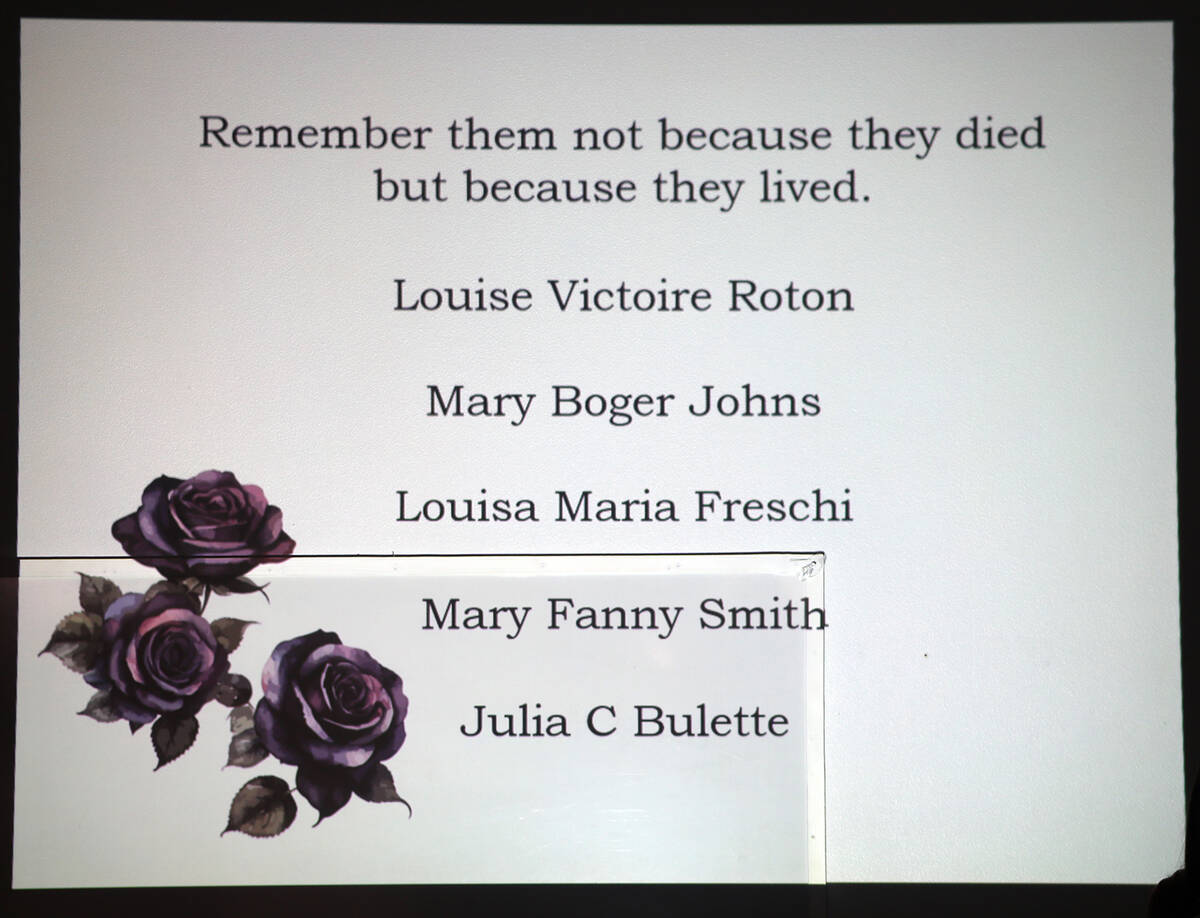
“These are names that I lived with for over 10 years while I was researching and writing this story,” Flinchum said. “The names are Louise Victoire Roton, Mary Boger Johns, Louisa Maria Freschi, Mary Fanny Smith and Julia C. Bulette. These are five women who were murdered between the years of 1856 and 1867 and that’s what this book is about. It is about as much as I could learn about their lives and as much as I could learn about their deaths – and what that could tell us about their place in society and their role in history. And of course, all five of these women were murdered but the way we access this story is through Julia Bulette.
“I don’t, in the end, know whether John Millian killed all of these women, some of these women or none of these women. But in this book, I talk about how each woman died and the evidence that was available to police at that time,” she told the audience. “Ultimately, I come down on the side of thinking that he probably did kill Julia and he might have killed a couple of the woman in San Francisco. But if you are interested in reading the book, you can decide that for yourselves.”
“The Redemption of Julia Bulette: Murder, Myth and the Hunt for a Serial Killer in Early Virginia City” is available online, although Flinchum encourages people to buy them directly through the Pahrump Valley Museum or Shoshone Museum.
Contact reporter Robin Hebrock at rhebrock@pvtimes.com