
Manse Tech rep speaks at water board meeting
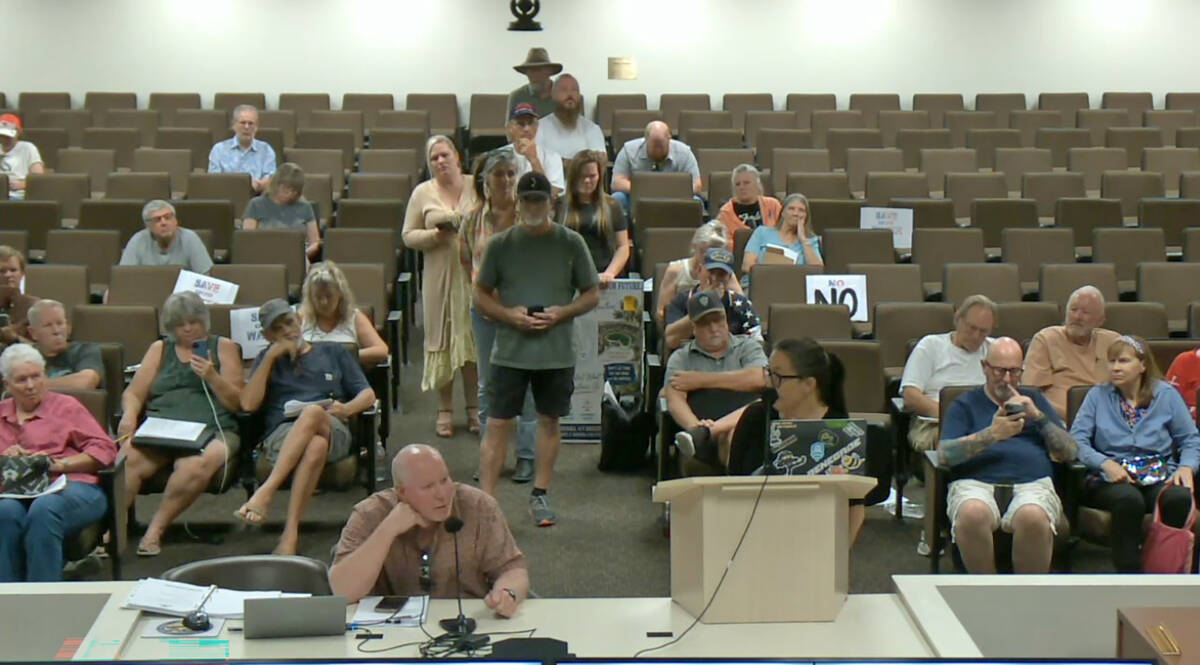




Large-scale data center development has been the talk of the town in recent weeks and with water at the heart of the concerns being voiced by locals, the Nye County Water District Governing Board hosted a discussion on the issue at its meeting this month.
Taking place Thursday, August 6, the water board meeting included an agenda item for a presentation from Double M Construction on the proposed Manse Technology Campus, a 900-acre data center that developer Gigawatt Development aims to have constructed on the south end of the Pahrump Valley. The item came at the request of water board member Michael Lach and once again, it was a lengthy discussion as board members and the public picked over the information being presented.
“We’re not voting on anything,” Lach reminded the audience as the item opened. “What we’re trying to do is, find out information. And remember, we’re trying to find out information because, as many people who don’t want this here in Pahrump, there are places in northern Nye County that want to see this stuff, they want it presented to them. So, the information we find out here, could go to use later. And as a water board, we’re the Nye County water board, not the Basin No. 162 water board.”
Russ Meads of Double M Construction headed up the presentation, which focused on what falls directly into the water board’s purview – water quantity and water quality.
Meads explained that the Manse Tech Campus is proposed for land that was previously owned by another developer and had been approved for a large, master-planned housing community some time in 2007, with an associated development agreement. Under that agreement, the previous developer was authorized to build thousands of single-family and multi-family dwelling units, along with incorporating open space and a section for general commercial buildings.
Using a projection of 5,700 home sites, WSP’s engineering report showed total water use for the previously approved residential subdivision would have come to 1,915.45 acre-feet per year. Adding in water use on open space and in general commercial space, total usage would have come to 1,944,58 acre-feet annually.
The Manse Tech Campus data center, on the other hand, would only use a fraction of that amount, Meads asserted. Calculating potable use, such as toilets and sinks, with non-potable use, to include charging and maintaining the closed-loop cooling system and adhering to outdoor landscaping requirements laid out in Nye County code, total use for the data center would come to 192.77 acre-feet annually, according to the WSP engineering report. This is far less than the originally announced use of up to 300 acre-feet per year, which Meads noted was estimated prior to WSP’s engineering report on the subject.
Meads also said usage is expected to be much lower, as the developer is aiming to apply for a waiver to allow for water-neutral landscaping. If authorized, that would drop water use by about 100 acre-feet per year, to 92.77 acre-feet, according to engineering standards. Even this is higher than the anticipated actual use, Meads said, noting that engineering firms often use inflated water-use projections.
“I believe we are talking about well over 1,500 acre-feet of savings from what we could have [at a residential development on the same site],” Meads concluded.
Lach’s first question was how the 1,500 acre-feet in water savings would materialize, stressing that the only real way to save water is to retire water rights back to the state, so they cannot be used for another purpose in the future.
Meads replied that he has had discussions to that effect with the developers of Manse Tech Campus and they are amenable to the idea of retiring a chunk of their water rights.
“I’m in 100% agreement with you that the savings have to be real savings, not just a presumptive savings,” Meads stated. “So, I’ve talked to the developers and what they are waiting on… is, we need to know if this is something that can even come about, before we even do that actual engineered study and retirement recommendation. That retirement recommendation… needs to be water-right-number specific. There are a lot of different types of water that are out there and I believe it needs to be some type of water right that is going to reduce actual use somewhere. Not something that is sitting on some ledger somewhere that isn’t actually going to be used, or is in an area that doesn’t matter.”
As to the system that would keep the data centers cool, Meads said this would be fully closed-loop, air-cooled and non-evaporative. The system would be charged with approximately one-third of an acre-foot of water, including chemicals to prevent freezing and mineral build-up, and then flushed every five to 10 years. The wastewater would be trucked in Nevada Division of Environmental Protection (NDEP)-approved containers to US Ecology, near Beatty, rather than being put into a local utility’s system.
When it comes to potential contamination risks, Meads noted that he too shares concerns about this and agreed with Lach’s assertion that a financial bond would not be able to fix things if the water were to be contaminated. However, he stressed that NDEP will review the project engineering, followed by Nye County, which can send the information to a third-party engineering firm for its review, all before any final approvals are made. He also touched on the leak detection and liner systems that are installed at mines throughout the county, adding that these, though quite expensive, could be required for Manse Tech Campus, to further protect against contamination.
Newest water board member Michael Faught said he still harbored concerns about contamination accidents and was not entirely satisfied, to which Meads said that is what the studies that will be forthcoming are for – to guide the project moving forward and assure its safety. Water board chair Helene Williams then pressed Meads on why the specific location has been selected. Meads explained that its proximity to existing electrical infrastructure, requirement to be hooked up to a utility and the fact that the developer owns the land all went into the decision.
Following questions from the board, the item opened to public comment and this took a different form than usual. Lach suggested a more free-form, back-and-forth discussion that allowed residents to speak and Meads to respond. Just as at previous county meetings, there was plenty of criticism from commenters, who expressed their distrust of the information being put out by the Manse Tech Campus team and their belief that the risk to Pahrump’s Basin No. 162 aquifer is simply too great.
“No tractor-trailer driver gets up in the morning and says, ‘Hey, I think I’m going to slide into a school bus full of kids and kill them.’ There are accidents that happen. We don’t want this here,” Pahrump resident Anthony Greco proclaimed, while Dwight Lilly emphasized, “If the water we do have gets contaminated, we’re done as a community. We have no other source of water.”
Others questioned whether the project was already under construction, to which Meads assured that the proposal is in the beginning stages and no construction has taken place. Lach added that many are confused about the large transformers that have been traveling to and through town, explaining that these are not related to Manse Tech Campus but rather, to GridLiance’s transmission line upgrades.
To view the entire two-and a-half-hour discussion, visit NyeCountyNV.gov and click on the “Meeting Center” link. The meeting video link is located next to the Nye County Water District Governing Board’s August 6 agenda.
Contact reporter Robin Hebrock at rhebrock@pvtimes.com