
AI and Data Centers: 101 draws a crown of concerned residents
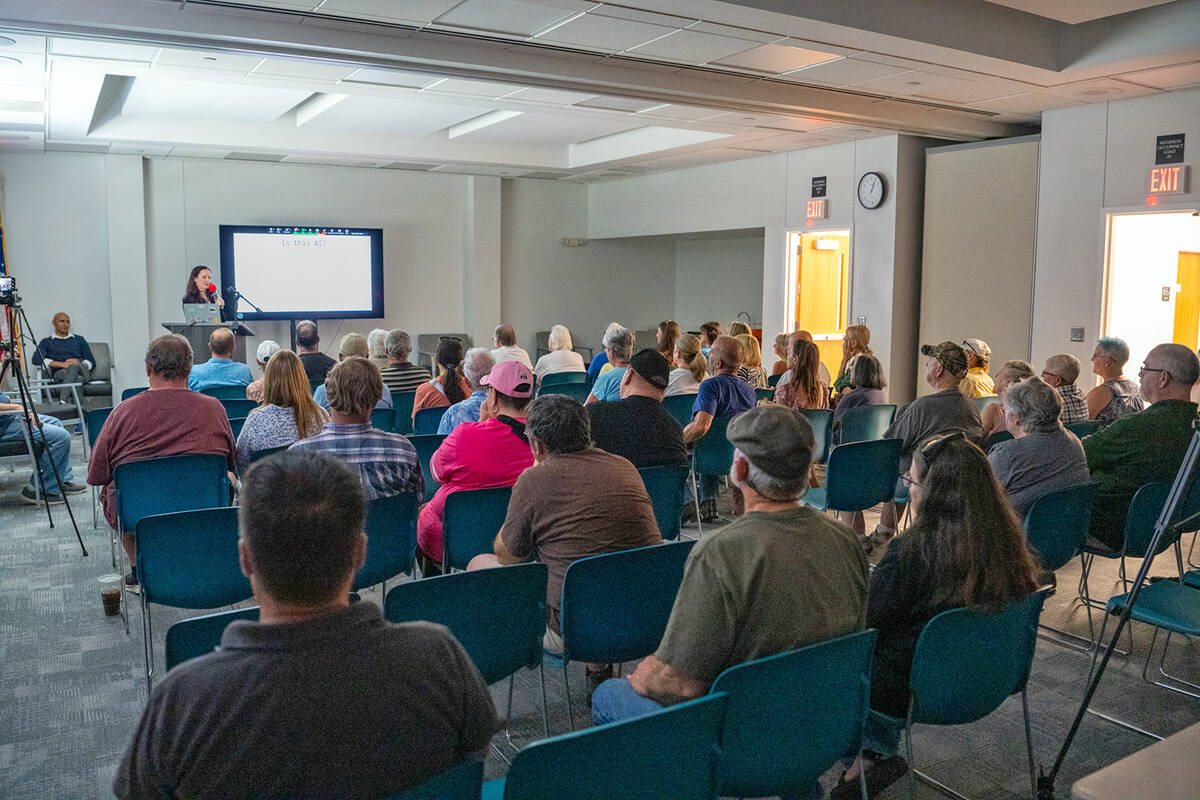
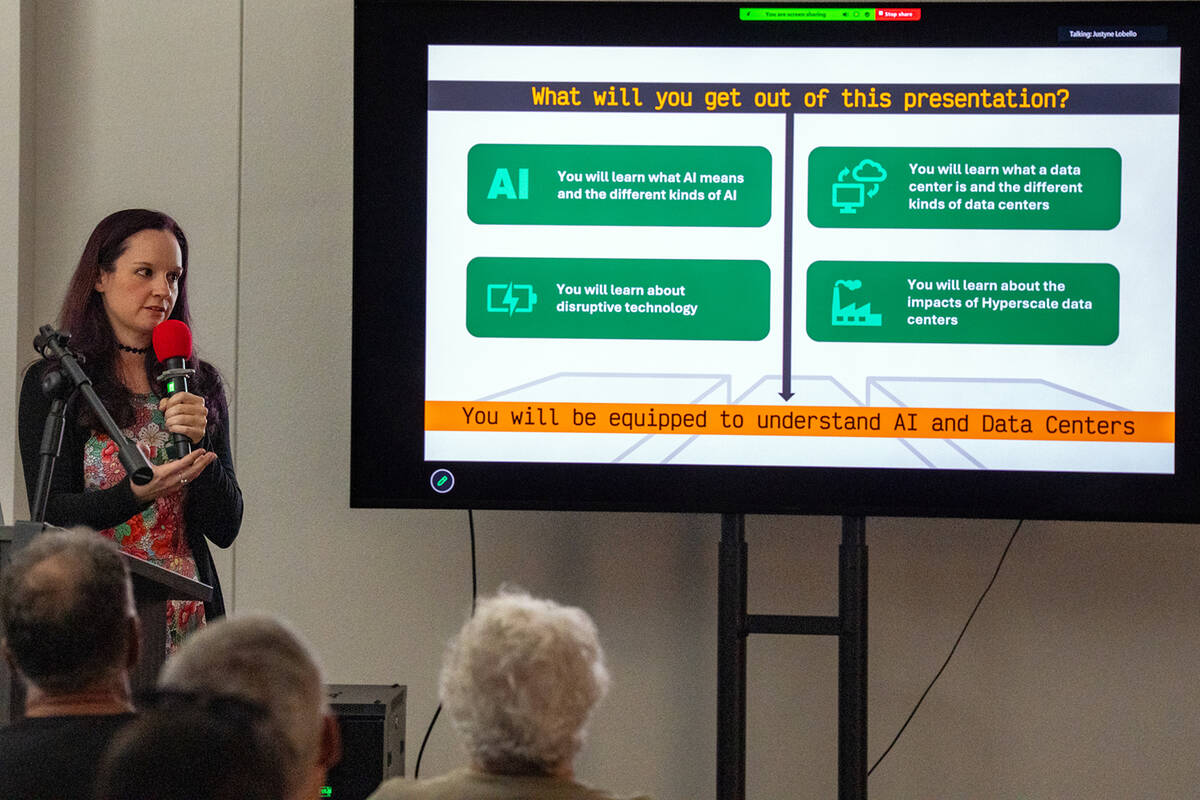
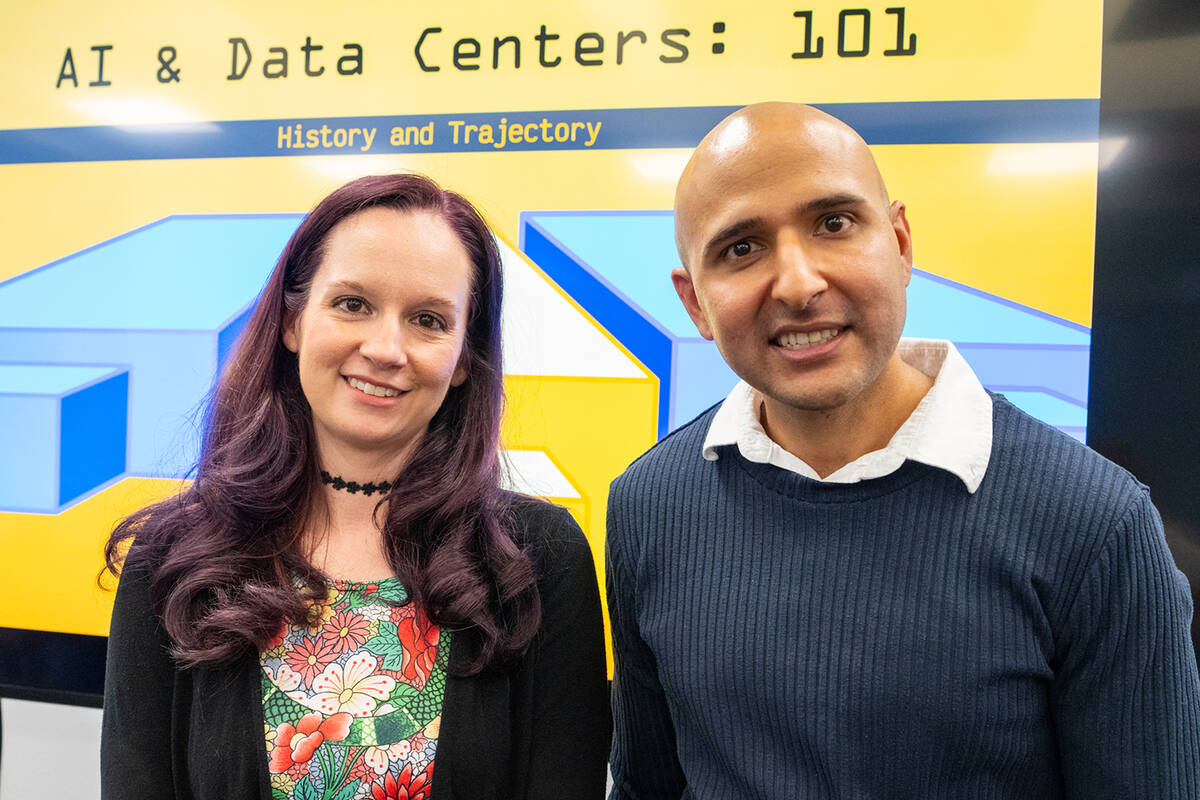



Pahrump resident Justyne Lobello has been in digital marketing for over 17 years and she has a deep familiarity with technology and when the community raised an outcry about potential data center development in the valley, she decided to put together a presentation to educate her fellow residents about what Artificial Intelligence (AI) is and how the data centers that support this technology could impact the area.
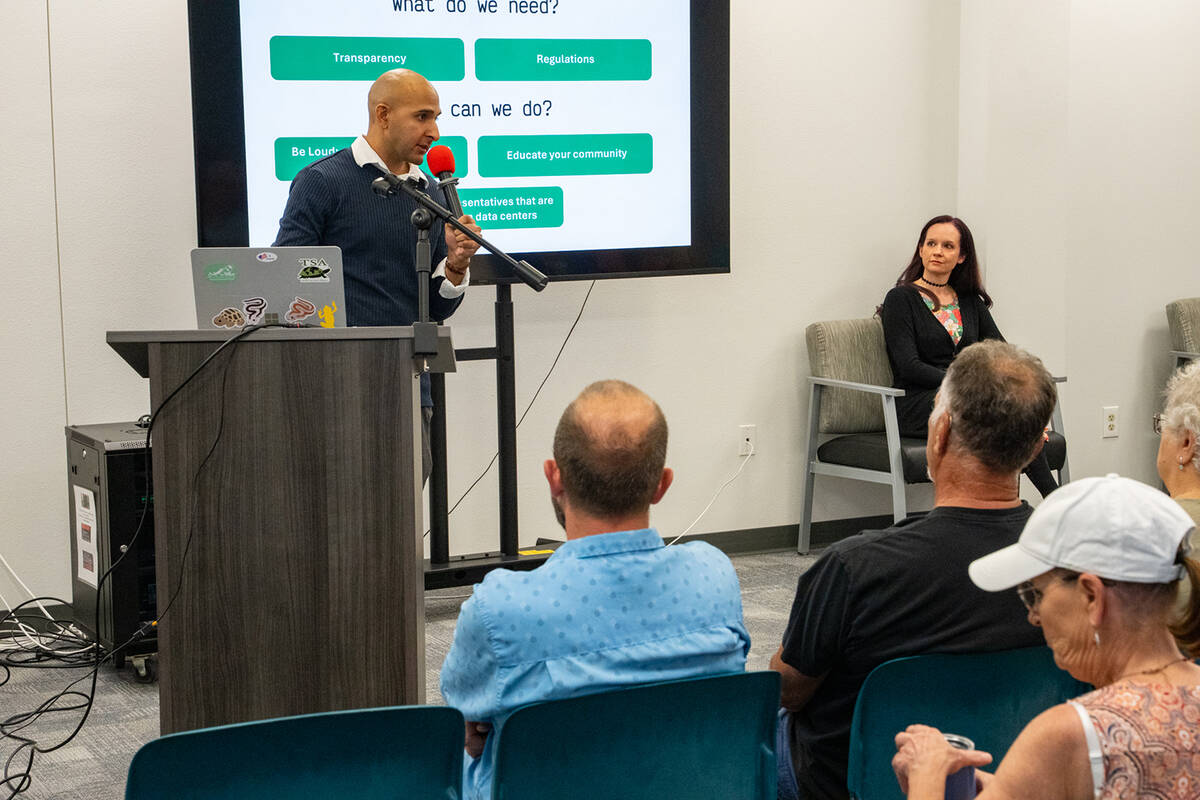
Titled “AI and Data Centers: 101”, the presentation took place at the Pahrump Community Library on Saturday, July 18, beginning at 1 p.m., right after the local data center protest that took place that morning.
“I do think that everyone is going to get something out of this presentation,” Lobello told the crowd. “This is going to equip you when you go to meetings like these meetings I hear are coming up with the commissioners. They might bring in data center experts and/or people who are involved in those projects - you’ll be able to translate what they are telling you, because they will use terminology that you may not be familiar with to make you feel more confident and comfortable about what they are saying, when they are actually saying something else.”
Lobello started off with a general overview of what is and is not AI, noting that AI technology has been used for decades. She emphasized that as it exists today, the technology cannot operate alone and needs human input but developers are working to eliminate this need. She then posed several questions to gauge whether people understood what was AI and what wasn’t, with mixed results.
Changing the color of text in a word document, for example, is not AI. Captions automatically generated for an online video, however, is AI, as is generating photos, videos or codes via specific inputs. A question entered into an online search can either be answered with or without AI.
Lobello then went over the difference between local AI versus cloud-based AI, explaining that searching for a subject in your phone’s photos utilizes local AI while activities such as image generation are cloud-based. She also detailed the various types of AI, such as machine learning and diffusion, but she primarily focused on Large Language Models, or LLMs, which is what allows for AI to answer questions, hold conversations, generate images, videos and code, create apps and programs, write copy and create reports and other documents.
Shifting to data centers, Lobello outlined the different types, which include: enterprise – those owned by a company; co-location – for renting out space on the data center; and edge – which is purpose-built for things like video game streaming. These are not always massive facilities, either, and she noted that before 2022, they were generally less than 100,000 square feet. The growth in AI, surveillance AI and crypto-coin mining, however, requires a huge amount of computing power and therefore, hyperscale data centers have become more prevalent.
“Data centers exist everywhere. Some of them are small, some of them are hyperscale,” she said. “So why are they going hyperscale? It’s all AI honestly.”
Lobello incorporated several videos in her presentation, as well, the first of which featured someone interacting with ChatGPT to ask how many times the letter “E” appears in the word “seventeen”. ChatGPT confidently replies, “Two ‘E’s, one in ‘seven’ and one in ‘teen’.” In another, a man discusses the potential for an “AI bubble” collapse. A separate video showed a trip U.S. Congresswoman Alexandria Ocasio-Cortez took to Morgan County, Georgia to speak with residents reporting negative impacts on their water by a closed-loop hyperscale data center in their area. In that video, residents showed her the discolored water coming from their taps, which they say only happened after the Meta data center was built.
One of the most intriguing for attendees was the video of an interview with environmental activist and advocate Erin Brockovich, whose role in the lawsuit against Pacific Gas &Electric resulted in an Oscar-winning film recounting her investigation. Brockovich is back in the spotlight as she steps forward to investigate reports from people across the country about the impacts that their communities are experiencing from data center development, ranging from concerns about land and wildlife, water, noise and potential health consequences. Within just 72 hours of launching a countrywide map to track reports of data center development and local effects, Brockovich said there were thousands upon thousands of submissions from 49 different states.
“So, what do we need? We need transparency and we need regulations. If we don’t have these then we’re going to keep fighting battles,” Lobello asserted. “So, what can we do? Keep being loud, attending meetings like this one, attending the local meetings from the commissioners, the water board, even the electric board. Any of those that you can go in, go in and talk about it. Don’t let them have a way to sleep. Make their lives difficult. And protests do work, guys, so thank you for doing that.
“Educate your community. Take the information you learned here,” she concluded. “Tell people about the difference between the data centers we used to use and the AI we’re using versus the AI that’s online. Data centers themselves are not bad. AI itself is progress. But there is a way to do it right and there’s a way to do it wrong and I think we’re doing it wrong right now. And vote for people who are educated on data centers… people who understand the facts, who can support the facts and don’t try to gaslight you.”
Before opening the question- and-answer portion, Lobello turned the microphone over to Nevada Assembly candidate Dr. Jon Penn Junejo, who encouraged people to keep making their voices heard on the matter and stressed that elected officials need to listen.
“There’s so much we just don’t know about them and we see these companies that promise the world to try to get them in place because they are going to be profiting but what happens if someone gets sick down the road – five years down the line, 10 years down the line?” he remarked.
The data center tracking map can be found at BrockovichDataCenter.com
To view Lobello’s presentation in full, visit tinyurl.com/2jjnmeek
A county-sponsored forum on data centers is set for 10 a.m. tomorrow at the Nye County Commission Chambers. A presentation by Manse Technology Campus, a proposed Pahrump data center project, will take place Monday, August 3 at 6 p.m. at the Pahrump Nugget. The county commission will then hold a public hearing on a bill regarding a possible ban on data centers on Tuesday, August 4 at 10 a.m.
Contact reporter Robin Hebrock at rhebrock@pvtimes.com