
The fight for Pahrump’s water
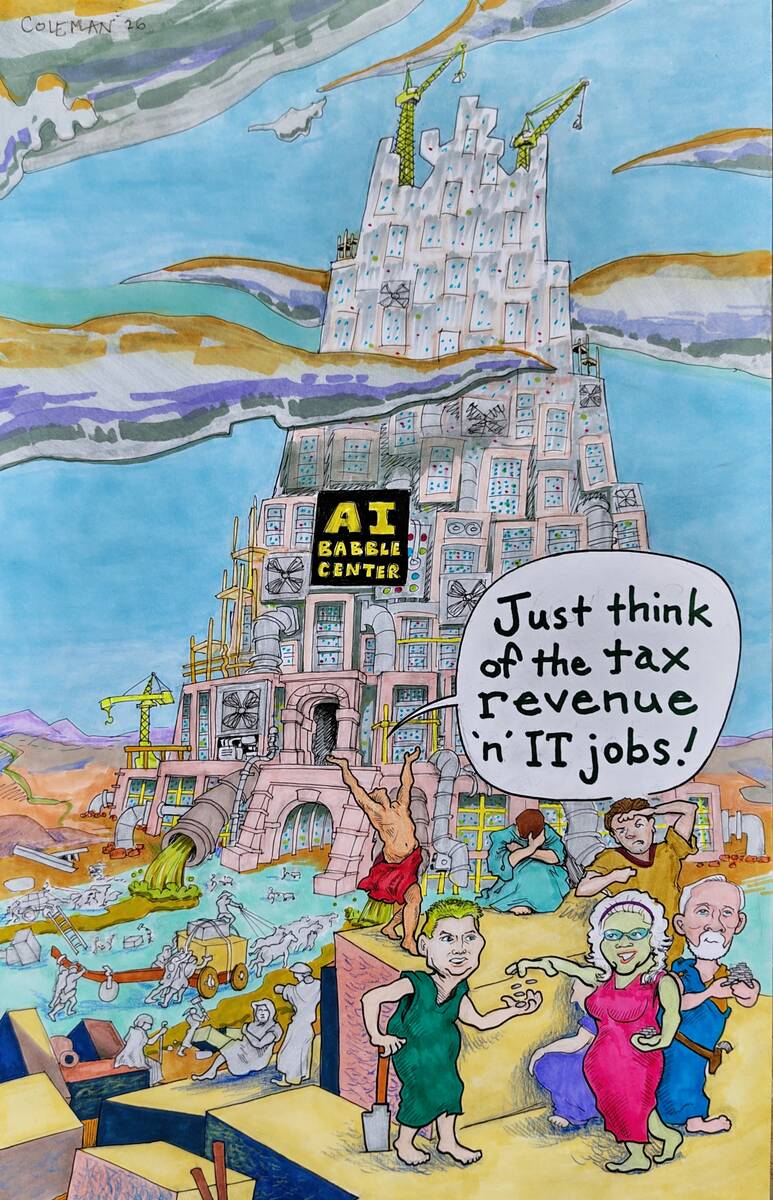





In March of 2026 Gallup asked Americans whether they favor AI Data Centers construction in their communities? The answer was seven out of 10 Americans oppose. That was country-wide. When it comes to building AI Data Centers in a desert like Pahrump, during what climate scientists call a ‘mega drought’, that number skyrockets. Why? Primarily because these data centers need water. Not just some water. A lot of water.
According to the Environmental and Energy Study Institute, a large-scale data center can consume up to 5 million gallons a day or 1.8 billion gallons annually. That is roughly the same amount that the 48,000 residents of Pahrump use.
Most of America’s 5,000 data centers are evaporative or water-cooled, because they are cheaper compared to air-cooled server farms. The air-cooled data hubs still use water to wash and flush equipment, just not in the millions of gallons a day range. Air-cooled data centers have their own unique problems, like an eerie drone that can be heard for miles and increased strain on a community’s electrical grid.
Neighbors to data centers often see their power bills rise dramatically, and sometimes, the potential power drain of these centers can become so staggering that residents get told that they will no longer be receiving any electricity at all.
Such was the case when Liberty Utilities, Lake Tahoe’s sole utility company, sent notices to their customers informing 49,000 Tahoe residents that their power was to be cut off, rerouted to AI data centers by May 31, 2027. After public backlash and jeers across social media, the residents of this Sierra Nevada tourist hub have had a reprieve. Electricity is going to continue flowing, as the utility company frantically scrambles to find alternate sources of power. It seems a crisis has been averted for the moment.
However, it still doesn’t negate the fact that in 2024 data centers used 22% of the state’s electricity, and that number is expected to rise to 35% by 2030, along with our power bills. (sources NV Energy &Investigative research reports by Fox 5 Vegas)
Scandals of the AI boom don’t stop there. Sometimes a data center is sold to the public as air-cooled and then becomes something else entirely. People who build and operate these massive server farms, that could put a town’s aquifer in jeopardy, do so to make money. Lots of money.
So, when the motivation is greed, it’s really no surprise when a bait and switch occurs. Like the situation that is developing in the Imperial Valley. From KLAS, “The developer behind a $10 billion data center has filed a lawsuit asserting his rights to Colorado River water.”
How much water? 260 million gallons a year. This agricultural region is the largest user of water from the seven states that depend on the Colorado River. Imperial Valley is where 80% of the country’s fruits and vegetables come from and 80% of the region’s water is allocated to farmers. Sabastion Rucci, a Huntington Beach lawyer and businessman, is pushing the plan.
KLAS further reports, “After two cities, El Centro and Imperial, snubbed Rucci’s bid to get recycled wastewater to cool the proposed data center, the developer went back on a statement that he had no intention of using water from the over-allocated Colorado River. The lawsuit claims the Imperial Irrigation District denied his water permit to use water from the river, breaking its own rules in the process by favoring one kind of water use over another.” Employing legalese and loopholes Rucci is basically arguing he has just as much right as food producers, which gives the anti-data center slogan, “Can’t Drink Data, Protect our Water,” even more credence.
A lesson in the axiom that trust is not freely given, it’s earned. Rucci gave an interview to the Wall Street Journal posted to their website July 18, titled, “He Ran a Strip Club, Now He Wants to Build California’s Biggest Data Center.” Who could have guessed he would have gone back on his promise to not take river water?
Will Pahrump suffer the same fate? A report from the Nye County Water District Governing Board stated Basin 162 under Pahrump is over-allocated now, before plans surfaced of a hyperscale data center. Josealonso Lozano put it best with her comment, “Isn’t most of Pahrump on well water? Yeah, that’ll go over well.”
Commissioners met on August 4th to discuss a data center ban. Seventy-seven people spoke against the proposed 900-acre server farm, with only nine people for the project, some of those friends and family of the developer. The former town manager-turned-consultant for Manse Technologies, Tim Sutton, brought up how the company has already spent hundreds of thousands of dollars for permitting, environmental impact studies and the like. Who asked them to do that? Isn’t there a data center moratorium in effect?
After some heated exchanges, Commissioner Bruce Jabbour came up with a compromise; let the people decide at the ballot box with a special election referendum question come January at the earliest. Some are concerned that this will be too late. The developers seem to be moving ahead at break-neck speed.
As the sponsor of the data center ban, Commissioner Ian Bayne put it, “The question is whether the government is negotiating in bad faith with the people of Nye County. If we are really going to let the people decide through a special election, then how can we allow data centers to move forward before the people have voted?”
At the end of the meeting Commissioner Bayne attempted to add a clause to sunset the ban upon results of the special election. The motion was not seconded. The next meeting where details of the proposed special election will be discussed is August 18th, 10 a.m. at the BOCC building, 2100 Walt Williams Drive in Pahrump. Show up or call in. Let your voice be heard.
Eric Coleman is a free-lance reporter living in Pahrump whose political cartoons appear weekly in the Pahrump and Tonopah newspapers. Contact him at ericjamescoleman@gmail.com.