
A helping hand for the bighorns


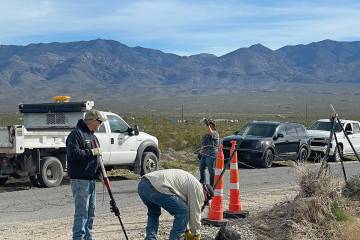

Already known as the driest in the nation, Nevada has been in a state of drought for much of the last century and it has only gotten worse in recent years.
Predictions by climate analysts show that these dry conditions are forecast to persist, too, with less precipitation falling and high temperatures both contributing factors.
And while humans may be able to conserve and manage this most precious of resources, that’s not the case for the Silver State’s many wild creatures.
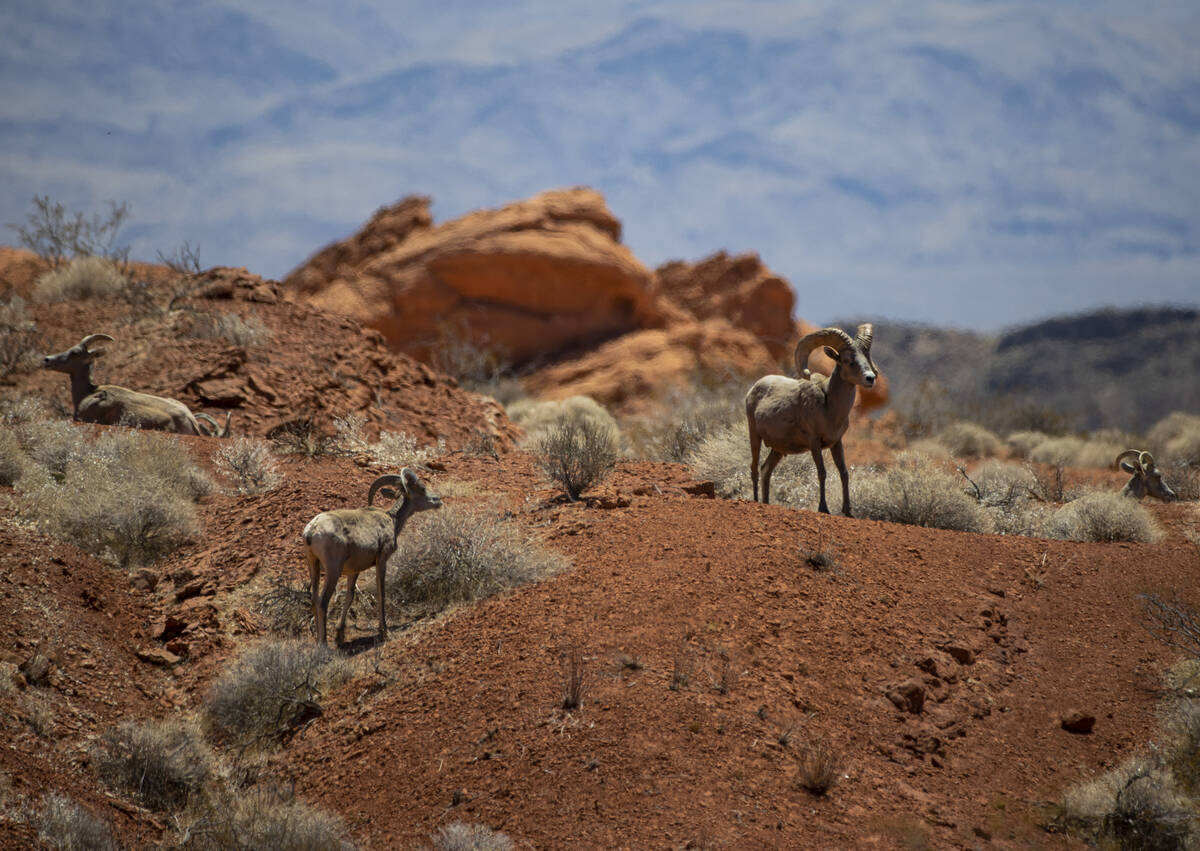
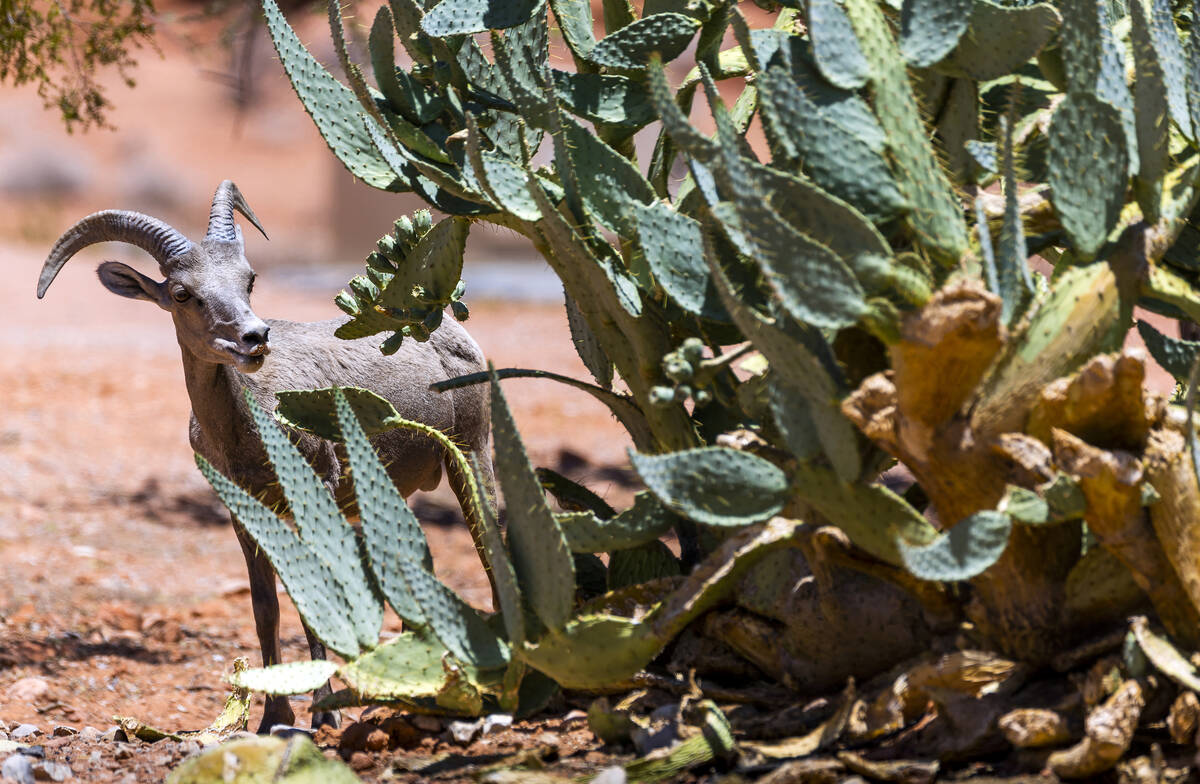
Natural water sources are becoming more scarce but the Nevada Dept. of Wildlife is doing what it can to help ensure the state’s wild populations, particularly its state animal, the bighorn sheep, doesn’t perish for lack of water.
“Severe drought conditions continue in Southern Nevada and that has the Nevada Dept. of Wildlife hauling water to guzzlers in the Last Chance Range near Pahrump,” NDOW Public Affairs/Conservation Education Supervisor Doug Nielsen announced this month. “As part of its ongoing efforts to help desert bighorn sheep and other wildlife impacted by ongoing drought conditions and limited water resources, NDOW spent Monday hauling 6,000 gallons of water to a guzzler located in the Last Change Range north of Pahrump.”
Nielsen noted that the effort was supported by several groups, including two local organizations, the Nye County Water District and Great Basin Water Company. Also assisting in the water haul was Alpha Landscaping of Las Vegas, which provided a water truck and drivers, as well as multiple other non-governmental organizations.
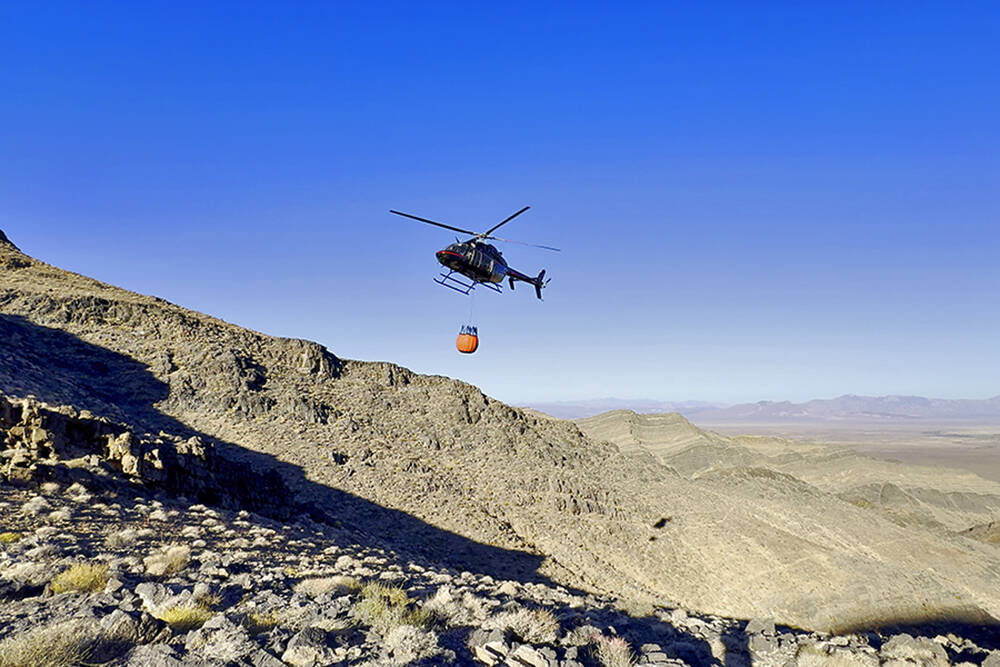
For the 2025 season to date, NDOW reported that it has delivered more than 150,000 gallons of water to guzzlers across the region. However, the monsoon season is proving to be drier than usual and that means more water hauls, so residents on the northern end of the valley can expect to see additional helicopter flights in the Last Chance Range over the coming days.
Providing some of the more technical details of the water hauls, Nielsen explained that the guzzlers that are used by NDOW are manmade water structures designed to capture and store rainwater that can then provide a valuable resource for bighorns and other animals during the scorching summer months.
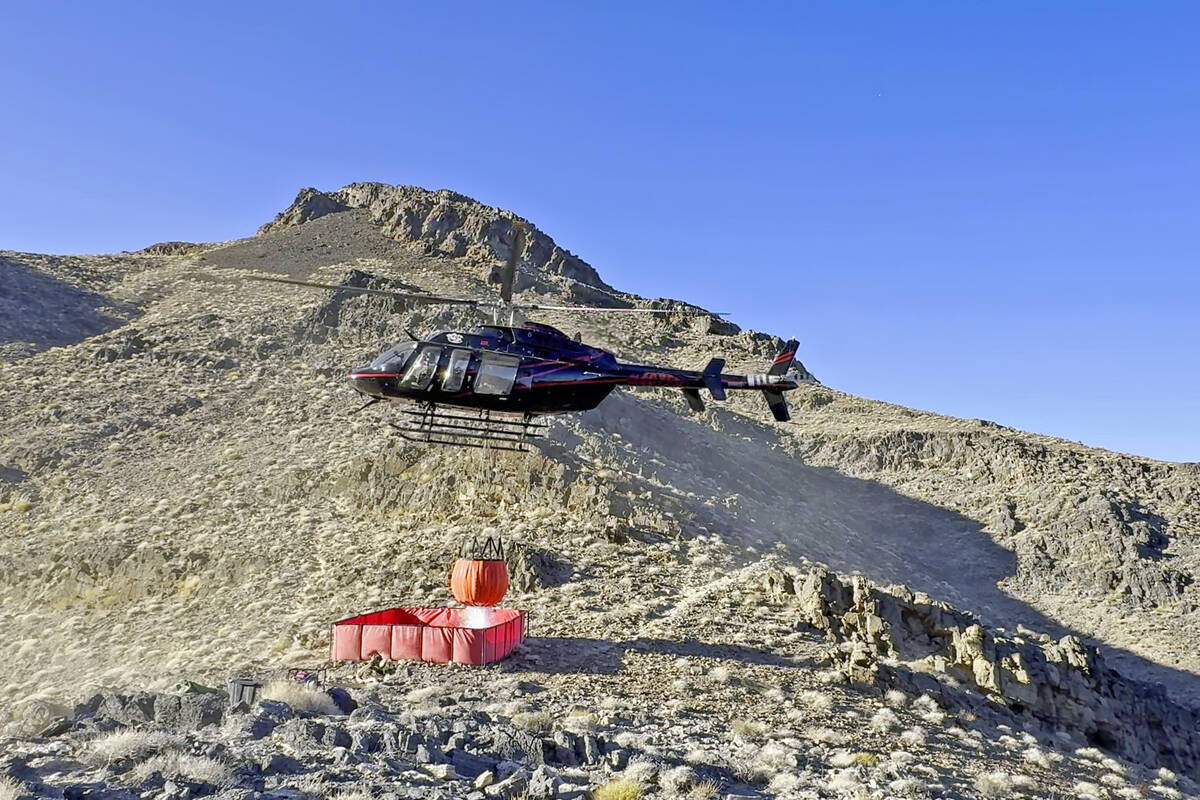
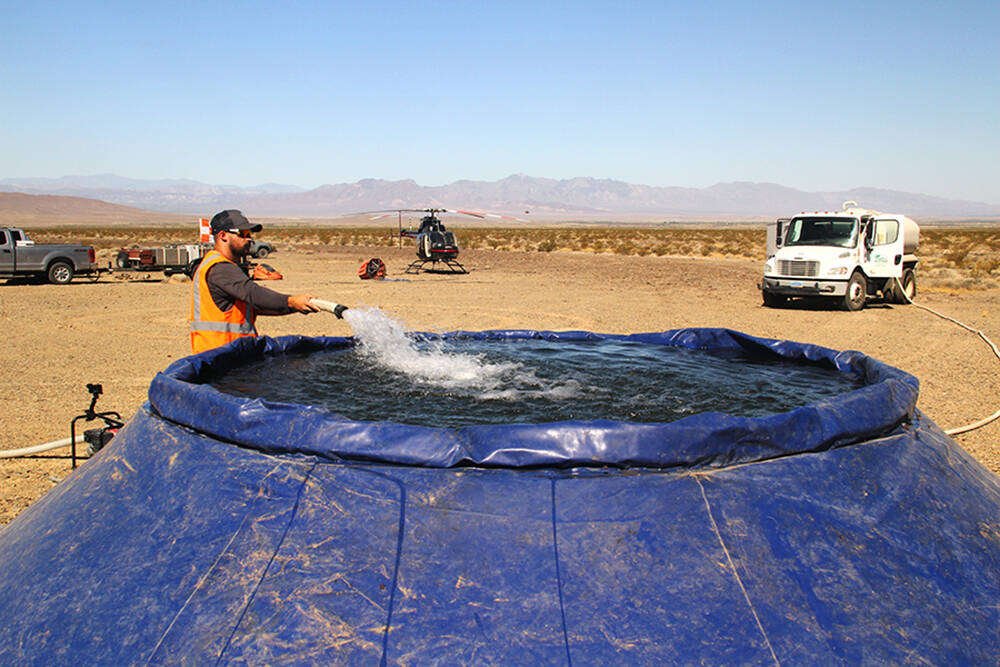
“Unfortunately, what little rain the area has received has not been enough to recharge either manmade or natural water sources,” Nielsen detailed. “Since guzzlers are in remote locations, NDOW slings water using helicopters and ‘Bambi buckets’, like those used to fight wildland fires. The pilot fills the bucket from a portable tank called a pumpkin and then flies to the designated guzzler.
“Once the pilot reaches the guzzler, they lower the bucket into another portable water tank and release the water. From that tank, the water is pumped into the guzzler’s storage tank and from there it flows into a drinker where wildlife can access it. In some cases, the water from the Bambi buckets is dumped onto a collector apron rather than into a portable tank,” he continued.
There is no doubt that the water provided by the guzzlers is a welcome respite for the animals but as NDOW Wildlife Specialist Joe Bennett noted, it is wet weather that is the real key to maintaining a healthy wildlife population.
“Water is only half the equation,” Bennett remarked. “You’ve got to have enough forage or ‘groceries on the ground’ to provide for these animals through time. And that takes rain.”
For more information on NDOW’s efforts visit NDOW.org
Contact reporter Robin Hebrock at rhebrock@pvtimes.com